
AM
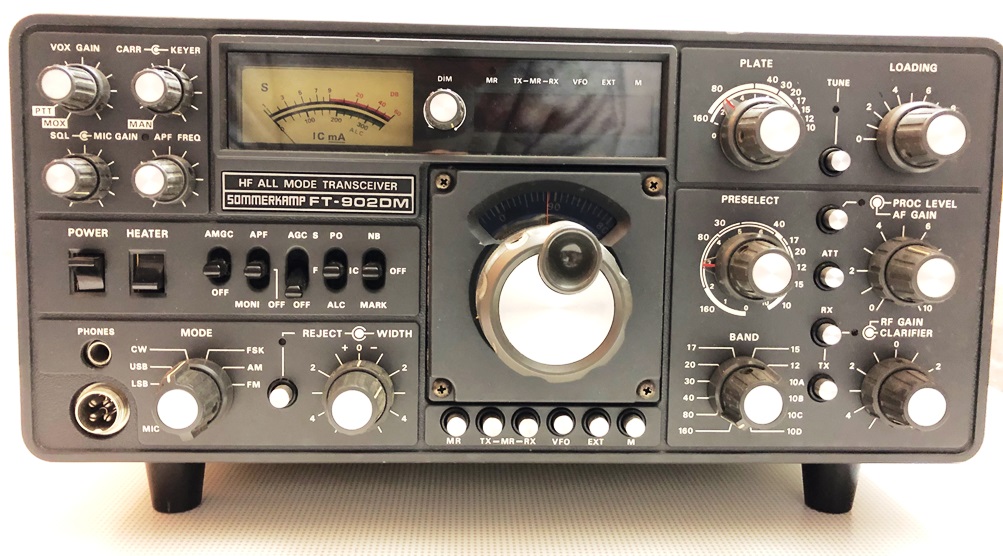
Amplitude modulation — the oldest modulation mode in the history of radio, usually used in amateur radio as single-sideband modulation (SSB).
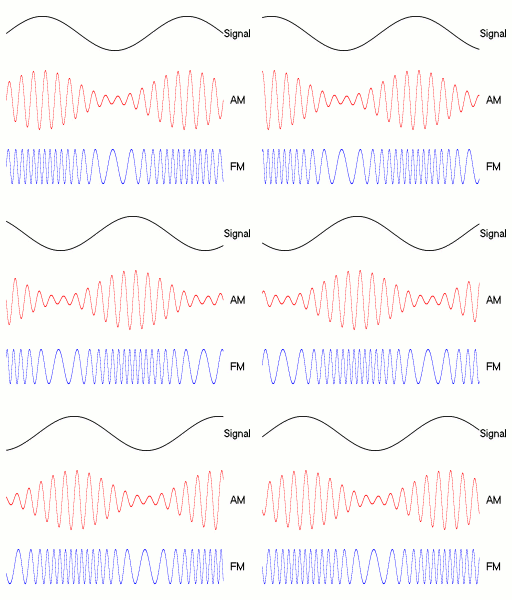
In amplitude modulation (AM), the amplitude of a high-frequency carrier wave varies in time with a low-frequency useful signal (speech, music). Low-frequency signals cannot be transmitted directly via a radio channel — they must first be shifted to a different frequency range. This is precisely what AM achieves. This shifting also allows several signals to be transmitted simultaneously without interfering with one another.
History
In the early days of radio broadcasting, amplitude modulation was the most important method of signal transmission. There were good reasons for choosing AM:
- Using simple means such as crystal detectors, primitive receivers could be built based on the principle of the envelope detector, requiring only a few components.
- There was as yet no method by which a frequency-modulated signal could have been generated or demodulated in the medium-wave band.
It was accepted that, with AM, a great deal of energy is expended on the emission of the carrier — only around one-third of the transmit power (at 100 per cent modulation, a maximum of 33 per cent) is contained in the two information-carrying sidebands — so only about 17 per cent per sideband. Over the years, as the number of transmitting installations and the sensitivity of receivers increased, a number of drawbacks became apparent:
- The bandwidth is twice as wide as the maximum modulation frequency. On medium wave, a 9 kHz channel spacing was introduced outside the Americas — this limits the audio bandwidth to 4.5 kHz (in practice 2–3 kHz).
- Slightly offset jammers produce an annoying whistling interference that causes significant disruption on shortwave over thousands of kilometres.
- In the event of selective carrier fading, the signal becomes unusable over long distances — the envelope-detector requires the carrier supplied by the transmitter to be in phase.
- Atmospheric disturbances (thunderstorms, ignition sparks from passing vehicles) disrupt AM reception more severely than any other modulation mode.
From today’s technical standpoint, traditional AM is obsolete — quality standards have risen, and modern components make it easier, cheaper and more energy-efficient to build FM or digital devices. However, for compatibility reasons, AM is unlikely to disappear entirely from the medium-wave band for a long time to come.
Spectral representation
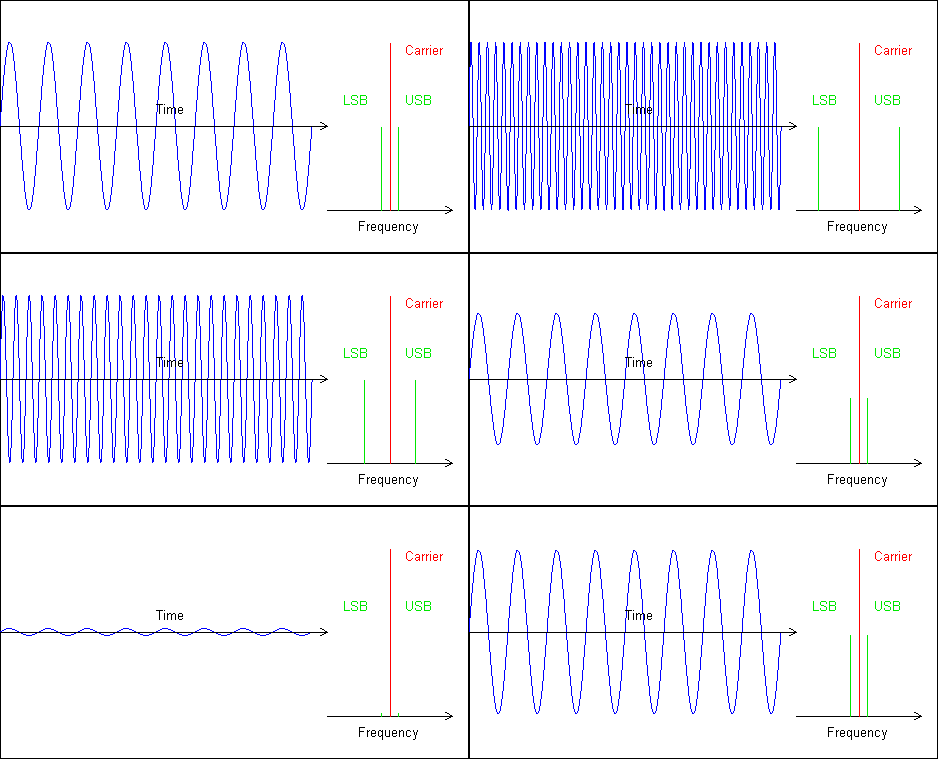
The modulation signal generates two additional frequencies symmetrical to the carrier frequency, the spacing between which corresponds to the instantaneous modulation frequency. If, for example, the modulation frequency varies between 300 Hz and 4,000 Hz, a frequency band with a total width of 8,000 Hz is swept — with a 600-Hz gap around the carrier. The upper region is called the upper sideband (USB), and the lower region the lower sideband (LSB).
In the case of speech or music, the sidebands change shape from moment to moment — they reflect the frequency spectrum of the modulating signal. Important: The amplitude of the modulating signal does not affect the carrier amplitude, but only the amplitude of the sideband frequencies. The carrier itself therefore does not carry any information at all — this is contained entirely within the two sidebands. Two important techniques have emerged from this observation:
- Dynamic AM — the carrier level is temporarily reduced during weak modulation.
- Single-sideband modulation (SSB) — the carrier and one sideband are completely suppressed; only the sideband carrying the information is transmitted. This variant has become the standard in amateur radio.
Applications
- Broadcasting on long, medium and short wave
- FM stereo (difference channel with suppressed carrier)
- Traditional television standards (video carrier)
- CB radio
- Amateur radio — usually in the form of single-sideband modulation (SSB)
- Aviation navigation (ADF and VOR)
- Aviation radio — civil 117.975–137 MHz, military in the UHF band
Source / further reading: Wikipedia — Amplitude Modulation (CC BY-SA).