
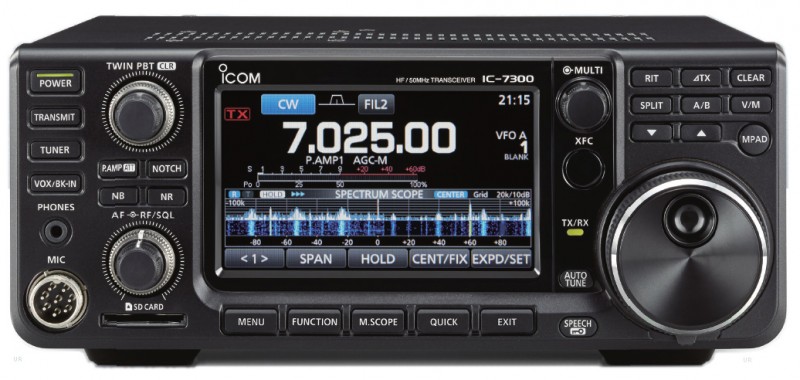
SSB
Single-sideband modulation — a spectrum- and energy-efficient modulation mode that has been the standard for analogue voice transmission on shortwave since the 1960s.
Single-sideband modulation (ESB; now more commonly known as SSB — from the English ‘single-sideband modulation’) is a spectrum- and energy-efficient modulation mode for voice transmission. It is used on analogue radio contacts such as shortwave for maritime radio, long-distance aeronautical radio, in military applications, as well as in amateur radio and CB radio. SSB was developed in the 1930s by telecommunications authorities — initially for the wired transmission of telephone calls over long distances, and later also for transcontinental radio links. In analogue voice radio for amateur radio, SSB almost completely replaced the traditional amplitude modulation (AM) during the 1960s — today, SSB is the standard for analogue voice QSOs on shortwave.
Characteristics
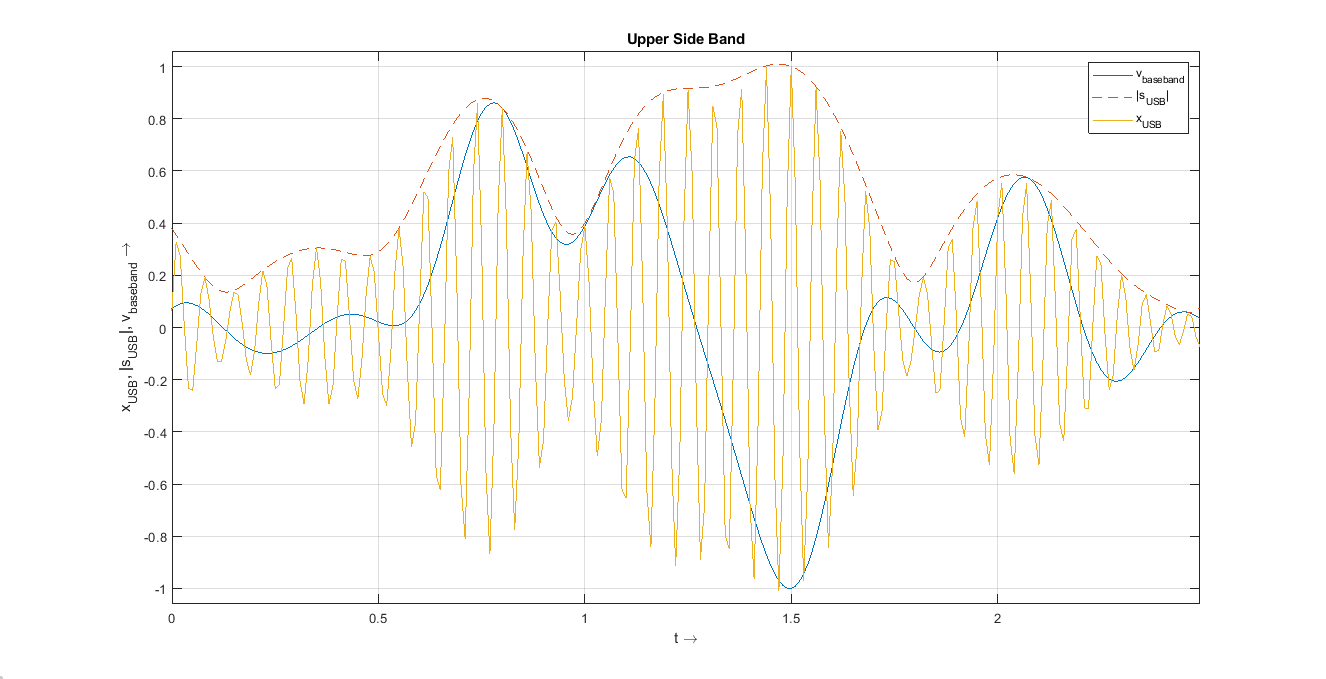
Unlike AM, SSB does not transmit any redundant signal components — such as a second sideband. SSB is usually transmitted with a suppressed carrier (there are also variants with a carrier or with a reduced carrier amplitude). With a suppressed carrier, the entire transmission energy is used for the information content – which, given a fixed transmit power, results in greater ranges and better signal-to-interference ratios. The effect of multipath propagation is also less pronounced with SSB than with AM.
Compared with amplitude modulation with a suppressed carrier, SSB has the advantage of halving the bandwidth. The disadvantages are the greater circuit complexity and consequently higher costs for SSB-compatible radio transceivers; simple demodulation using an envelope detector is, in principle, not possible with SSB.
Unlike AM (with or without a suppressed carrier), which does not affect the phase of the carrier frequency, SSB incorporates phase modulation of the carrier as one of its components — the greater the amplitude of the sideband signal relative to the carrier amplitude, the stronger this modulation becomes. Historically, despite this phase modulation, SSB is classified as an amplitude modulation technique. Owing to the high crest factor in high-frequency baseband signals, SSB is less suitable for pulse transmission and as a digital modulation technique.
Spectral representation
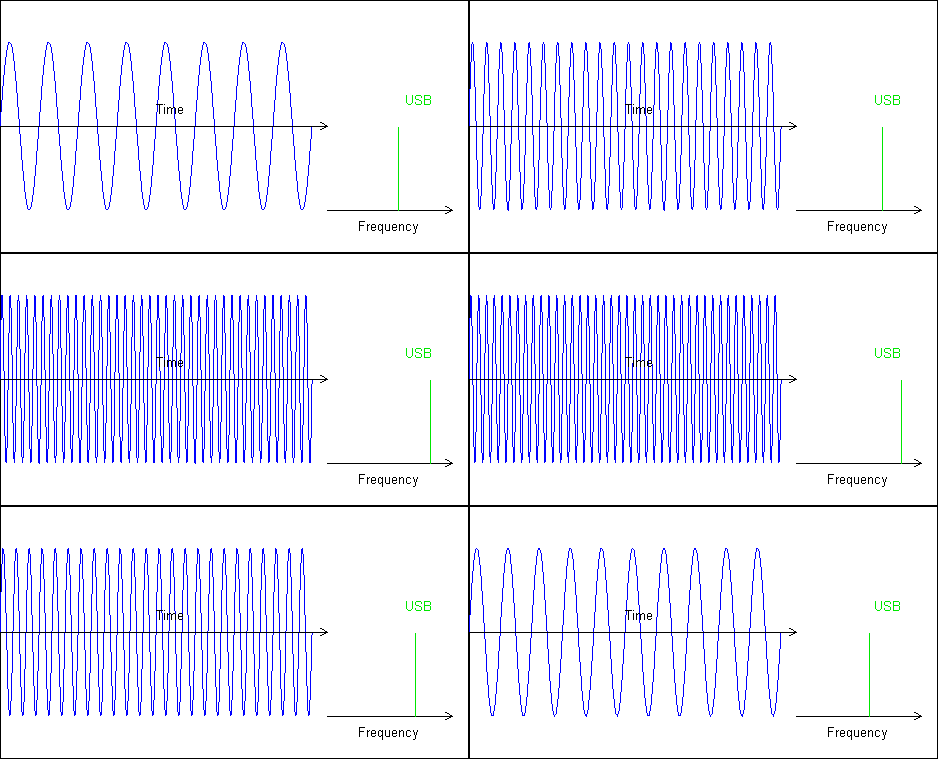
In AM, the modulation signal creates two additional frequency ranges symmetrical to the carrier frequency. If, for example, the modulation frequency varies between 300 Hz and 4,000 Hz, a frequency band with a total width of 8,000 Hz is occupied. The upper band is referred to as the USB (upper side band), the lower as the LSB (lower side band) — in AM, both contain exactly the same information.
In SSB with a suppressed carrier, only one of the two sidebands is transmitted. The spectral component varies in line with the baseband signal, whilst the envelope remains constant — so when the modulation amplitude is reduced, the transmit power decreases in the same proportion. The required transmit power is considerably lower due to the absence of a continuous carrier wave and varies between 0 per cent and approximately 12.5 per cent.
A disadvantage is that, without a transmitted carrier, there is no information as to where the carrier frequency required for demodulation lies in the spectrum. Whether USB or LSB is used must be agreed upon — in amateur radio, the rule is: above 10 MHz, USB; below 10 MHz, LSB.
In analogue SSB transmission with speech, the correct frequency can be found simply by manually tuning around the received signal — speech becomes unintelligible if the carrier deviation exceeds approximately ±100 Hz. With SSTV, a regular synchronisation pulse (burst signal) enables the carrier frequency to be adjusted automatically. Music sounds discordant even with a deviation of just a few hertz.
Generation
An SSB signal can be generated in several ways — the result is identical in all cases:
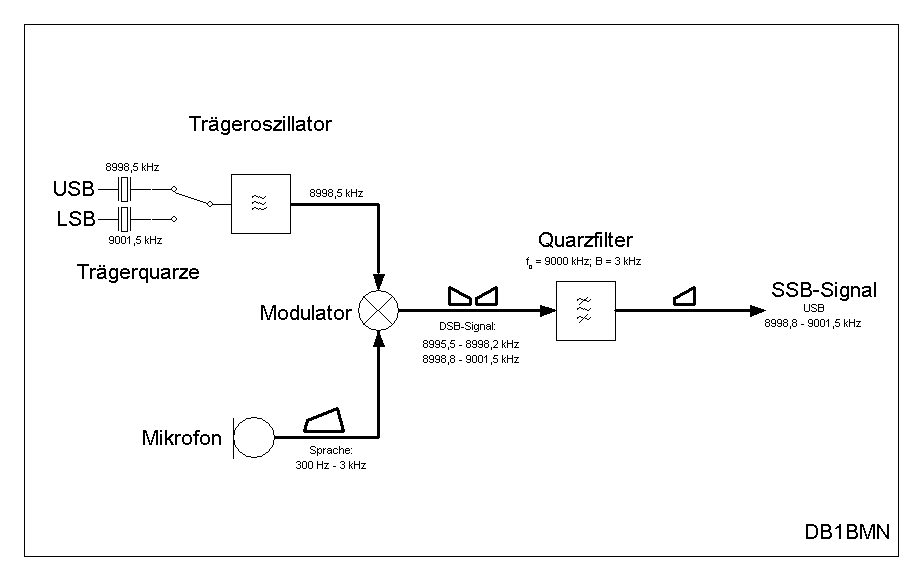
Filter method — begins with a mixer (typically a Gilbert cell) which generates an AM signal with a suppressed carrier. A narrowband band-pass filter with a high Q-factor (e.g. a quartz filter) allows only one of the two sidebands to pass. The fixed filter frequency is then shifted to the desired transmit frequency by a second mixing stage.
Phase method (also known as the single-sideband mixer or IQ method) — does not require an expensive filter. Two symmetrical mixers operate with input signals that are phase-shifted by 90° on both the AF and RF sides. Achieving an exact 90° phase shift across the entire voice band (300 Hz to 3,500 Hz) is challenging with analogue components.
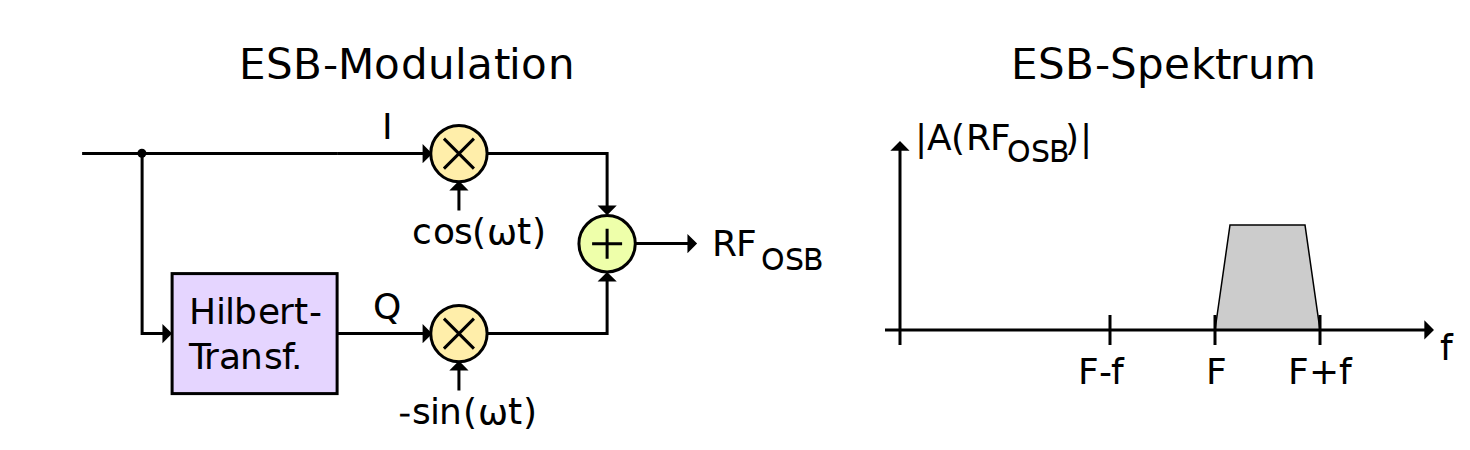
DSP method — now standard in software-defined radios. The real-valued modulation signal is converted into a complex baseband signal (‘analytical signal’) via the Hilbert transform, mixed with two phase-shifted carriers and added together. The phase shift causes the carrier to cancel itself out, and one sideband is suppressed — resulting in a single-sideband signal with a suppressed carrier. Pioneering work in this field was carried out by Donald K. Weaver (1950s).
Demodulation
Although the amplitude of the SSB signal bears a certain resemblance to the modulating low-frequency signal, SSB cannot be demodulated using a simple envelope demodulator — unlike non-coherent AM demodulation.
In an analogue SSB receiver (as is common in amateur radio), the received signal is mixed to a fixed intermediate frequency (IF) in a mixer stage using the superheterodyne principle and cleared of adjacent-channel interference by a steep-slope quartz filter. A second mixer stage — the product detector — carries out the demodulation by mixing in a locally generated carrier. The local carrier oscillator is known as a BFO (Beat Frequency Oscillator) or CIO (Carrier Insertion Oscillator).
Frequency deviations of the BFO result in a frequency offset, which can be fine-tuned to optimise speech intelligibility (pitch) — an offset of approximately ±20 Hz is considered acceptable. Some amateur radio receivers have an LSB/USB switch that sets the BFO to the lower or upper end of the IF passband.
A disadvantage of carrierless SSB is the difficulty in implementing automatic gain control (AGC) and automatic frequency control (AFC). This can be remedied by using SSB with a suppressed carrier and its regeneration in the receiver, or by transmitting an agreed pilot tone. Since the mid-1990s, analogue signal processing in the receiver has gradually been replaced by more cost-effective DSP — on shortwave, fully digital receiver designs are now commonplace, in which no analogue components are used for signal processing apart from the pre-selection stage before the AD converter.
Uses and special forms
In the broadcasting sector, the introduction of SSB as a replacement for AM was discussed for decades — but was never implemented following the development of digital transmission standards such as DRM and DAB. The main reason: with an AM channel bandwidth of just 9 kHz, the sound quality of SSB stereo would be unsatisfactory, and the necessary fine-tuning of the receiver in the hertz range would be too demanding for the end user.
One special variant is AM-compatible SSB (with the carrier transmitted alongside the signal) — this can also be received using standard AM demodulators. This modulation mode was used, for example, between 1953 and 1962 on a long-wave transmitter operated by Deutschlandfunk — a historical curiosity.
Another widely used variant is vestigial sideband modulation in analogue television transmission — which offers a significant improvement in energy and spectral efficiency compared to double-sideband AM. Unlike pure SSB, this method transmits a reduced carrier and part of the second sideband, which considerably simplifies and reduces the cost of demodulation on the receiving end (e.g. a TV set).
Source / further reading: Wikipedia — Single-sideband modulation (CC BY-SA).