LoRa
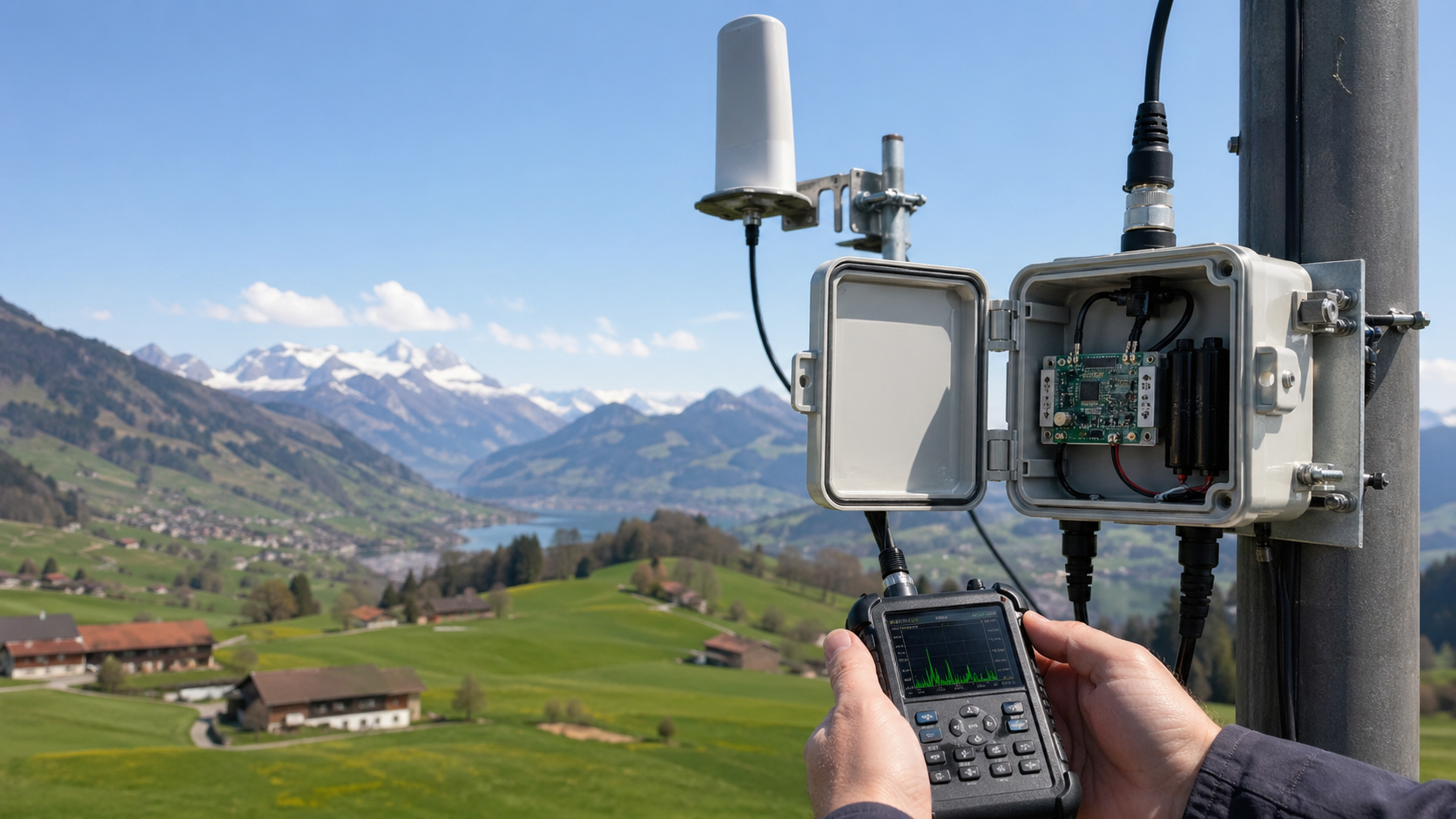
Long Range, Low Power — wireless IoT technology operating at 868 MHz and 433 MHz using Chirp Spread Spectrum (CSS), with ranges of several kilometres and battery life lasting for years.
What is LoRa?
LoRa stands for ‘Long Range, Low Power’ and refers to a wireless communication technology developed to transmit data over long distances. This technology is frequently used for the Internet of Things (IoT) and machine-to-machine (M2M) communication. LoRa offers a means of wireless data transmission over long distances with low energy consumption, making it particularly well-suited to battery-powered devices and applications that require a long battery life. The key features of LoRa are:
- Long range: LoRa technology enables data to be transmitted over distances ranging from several kilometres to tens of kilometres, depending on environmental conditions and the hardware used.
- Low power consumption: LoRa devices are energy-efficient and can therefore be powered by batteries or other energy-efficient power sources. This makes them ideal for applications where battery consumption needs to be minimised.
- Low data rates: LoRa offers comparatively low data rates compared to other wireless technologies such as Wi-Fi or 4G/5G. However, this is sufficient for many IoT applications where only small amounts of data need to be transmitted occasionally.
- Long battery life: Due to the low power consumption and efficiency of LoRa devices, they can often be operated for years without the need to replace the battery.
LoRa is based on a modulation technique that enables signals to be received even under poor radio conditions. This technology is often used in conjunction with LoRaWAN (LoRa Wide Area Network), a wireless network protocol specifically designed for communication with LoRa devices. LoRaWAN enables communication between LoRa devices and a central LoRaWAN network server, which processes and forwards the data collected from the devices. LoRa and LoRaWAN have a wide range of applications, including smart cities, environmental monitoring, asset tracking, agriculture, smart buildings and much more. They offer a cost-effective way to provide wireless connectivity for IoT applications spread across large geographical areas.
Bandwidth vs. Range
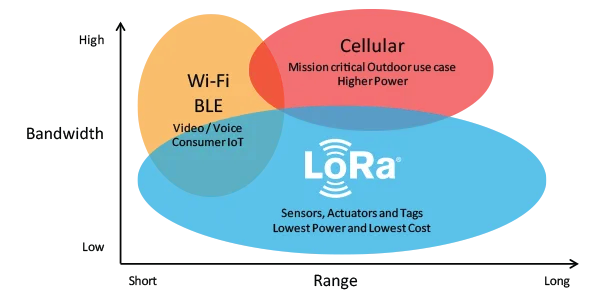
LoRaWAN is suitable for transmitting small amounts of payload data (such as sensor data) over long distances. LoRa modulation offers a significantly greater communication range at lower bandwidth than other competing wireless data transmission technologies. The figure below shows some access technologies that can be used for wireless data transmission and their expected transmission ranges compared to bandwidth.
Frequency bands
Here are the most common frequency bands for LoRa (depending on the region and regulatory requirements):
- 868 MHz: The most commonly used frequency band for LoRa technology in Europe due to its excellent range and penetration characteristics. In North America, the 915 MHz band is used. The exact frequency ranges may vary by country, as regulatory authorities determine the use of specific frequencies. The transmit power is limited to 15 dBm (25 mW ERP), and transmission is permitted for only 1 per cent of the time (duty cycle).
- 433 MHz band: The 433 MHz band is also used in Switzerland for LoRa communication, although it is less common than the 868 MHz band. As part of the 70-cm amateur band, it may be used by licensed radio amateurs at the permitted, significantly higher transmit power and without the 1 per cent duty cycle restriction of the ISM band.
- 2.4 GHz band: In some regions, LoRa is also used in the 2.4 GHz band. This band is used worldwide for Wi-Fi and other wireless technologies, and the use of LoRa in the 2.4 GHz band may therefore be subject to greater interference.
Data rates
Depending on the configuration, transmission rates for LoRa in the sub-GHz band range from a maximum of 125 bps (bits per second) to a few bits per second when a long range is required.
“Chirp Spread Spectrum” (CSS) modulation mode
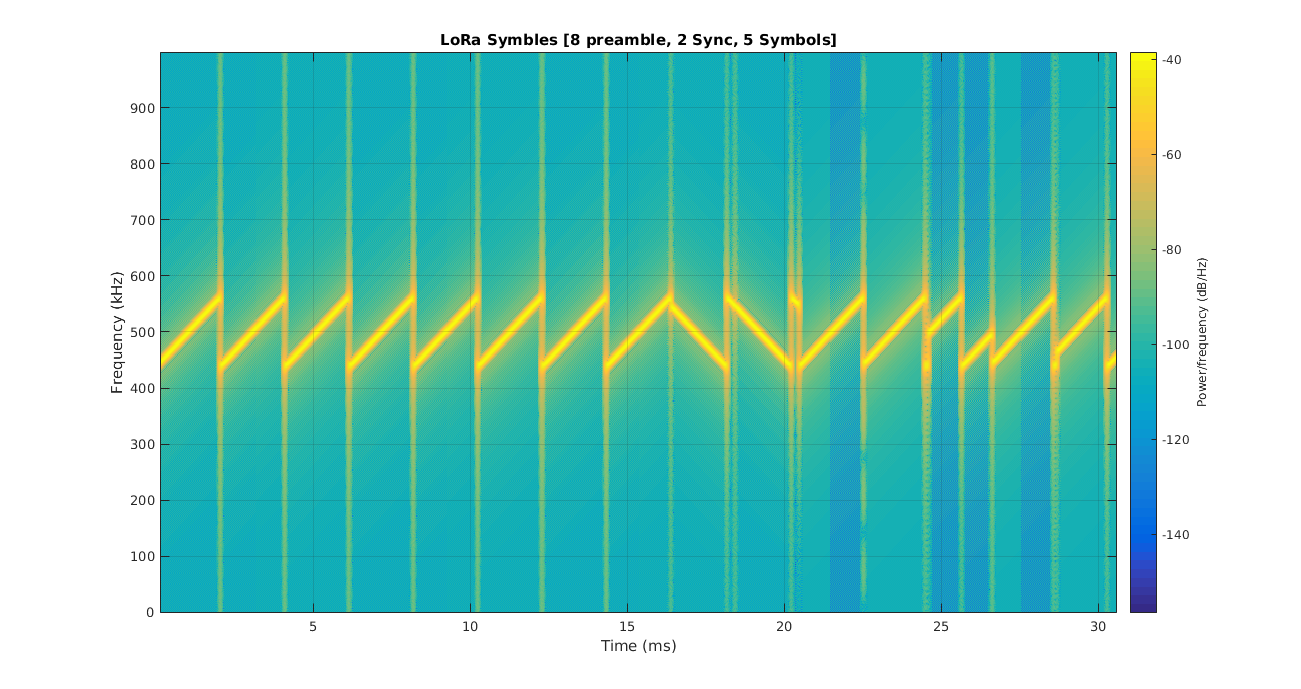
LoRa (Long Range) uses a special modulation mode called ‘Chirp Spread Spectrum’ (CSS). Chirp Spread Spectrum is a type of frequency modulation in which the frequency of the carrier signal is varied linearly over time, a process known as a ‘chirp’. This chirp requires a very wide bandwidth (typically 125 kHz).
LoRa uses three different bandwidths: 125 kHz, 250 kHz and 500 kHz (in this example, 125 kHz is used). LoRa symbols are modulated using a 125 kHz bandwidth up-chip, and different orthogonal spreading factors are used depending on the data rate requirements and channel conditions. LoRa uses spreading factors SF7 to SF12. A higher spreading factor provides greater range but a lower data rate.
Here is a spectrogram of a LoRa emission (chirp spread spectrum):
Practical applications of LoRa in amateur radio
LoRa APRS
A LoRa APRS system has been set up in parts of Switzerland. It uses LoRa modules in the 433 MHz band and operates at a significantly lower power level than traditional APRS on 2 m. The widely used firmware was developed by Ricardo Guzmán (CD2RXU): LoRa_APRS_Tracker and LoRa_APRS_iGate.
Meshtastic
Meshtastic is the most popular open-source LoRa mesh project. Low-cost LoRa modules (e.g. Heltec, LilyGO T-Beam or RAK) form a self-organising network and exchange text messages, position and sensor data — it is conveniently operated via a smartphone app using Bluetooth. Each node forwards messages (flooding), enabling the network to self-heal; this is particularly well-suited to mobile stations (hiking, cycling, events). In Europe, Meshtastic operates on the 868 MHz ISM band (max. 25 mW ERP) — this is licence-free operation and not amateur radio, even though many radio amateurs take part. Find out more at: meshtastic.org.
MeshCore
MeshCore is a newer alternative (since 2025) running on the same hardware, but with more efficient routing: instead of flooding all messages, MeshCore learns the paths to the destination and sends subsequent messages specifically via the appropriate intermediate nodes. It recognises three device roles — Companion (the personal end device), Repeater (a pure repeater) and Room Server (which stores group chats and delivers them to offline participants). This allows MeshCore to scale better in networks with permanently installed repeaters. MeshCore also operates predominantly on the 868 MHz ISM band. Find out more at: meshcore.co.uk.
MeshCom
MeshCom is the LoRa mesh specifically designed for amateur radio. It operates in the 70-cm band (433.175 MHz for text, 433.775 MHz for positions), transmits unencrypted and identifies each node with its call sign — thus ensuring that operations remain compliant with amateur radio regulations, utilising the higher power levels and better antennas permitted under those rules. MeshCom gateways connect local mesh islands via the internet or HAMNET to form a large, shared network. The project was initiated by the ÖVSV (ICSSW) and runs on ESP32 boards (Heltec, LilyGO T-Beam, RAK) using its own firmware. Find out more: wiki.oevsv.at/MeshCom.
Monitoring LoRa satellites
LoRa is also used by microsatellites (PocketQubes, CubeSats) to transmit telemetry. TinyGS is an open, global network of ground stations that receive signals from these satellites: Using an affordable ESP32 LoRa board (e.g. Heltec or TTGO), you can build your own receiving station for just a few francs, which automatically reports the received packets to the shared TinyGS network and displays them on a global map. Find out more: tinygs.com.
LoRaWAN
LoRaWAN (Long Range Wide Area Network) is a wireless communication protocol developed specifically for the Internet of Things (IoT) and based on LoRa (Long Range) technology. LoRaWAN extends LoRa technology by providing a network protocol that enables communication between LoRa-enabled end devices and a central network server. Here are the key components of LoRaWAN:
- End devices (LoRa nodes): These are the IoT devices that collect or control data and communicate with the LoRaWAN network. These devices are usually equipped with LoRa radio modules and may contain various sensors, actuators or other IoT components.
- Gateways: LoRaWAN gateways are devices that receive data from the end devices and forward it to the central network server. These gateways are strategically placed within an area to ensure good coverage.
- Network server: The central network server is the heart of a LoRaWAN network. It receives data from the gateways, processes it, forwards it to the correct applications and ensures that communication is secure and reliable. A well-known public network server is The Things Network (TTN).
- Applications: Applications and services that access and utilise the data collected by end devices to meet specific requirements. These can include applications for monitoring environmental conditions, asset tracking, smart cities and much more.
LoRa Alliance
The LoRa Alliance is an independent, non-profit organisation that plays a key role in promoting, developing and standardising LoRaWAN technology. Its main objectives and tasks include:
- Standardisation: The LoRa Alliance works to develop and promote open standards for LoRaWAN. This helps to ensure interoperability between different LoRaWAN devices and networks and to foster widespread adoption of the technology.
- Certification: The LoRa Alliance operates a certification programme that ensures LoRaWAN devices and networks comply with the defined standards. This promotes the quality and reliability of LoRaWAN implementations.
- Promotion of the technology: The LoRa Alliance works to raise awareness of LoRaWAN and its use cases. This is achieved through marketing initiatives, events and educational efforts.
- Advocacy: The LoRa Alliance represents the interests of its members and the LoRaWAN community at a political and regulatory level. This involves collaborating with regulatory bodies and supporting policies that promote the use of LoRaWAN.
- Ecosystem development: The LoRa Alliance promotes the development of a comprehensive LoRaWAN ecosystem by bringing together companies, research institutes, developers and users. This contributes to innovation and the further development of LoRaWAN.
- Development of specifications: The LoRa Alliance works on the development of LoRaWAN specifications to ensure that the technology meets the changing requirements and challenges of the IoT.
The LoRa Alliance has a broad membership base comprising companies, research institutions and other organisations interested in promoting and further developing LoRaWAN. Its efforts have helped to make LoRaWAN a widely used and accepted technology for the Internet of Things (IoT) and to promote the global availability of LoRaWAN networks and devices.
The Things Network
This is a LoRaWAN network founded by enthusiasts, consisting of many private gateways and an open network. It can be used free of charge by all sensors.
Helium
This is a closed LoRaWAN network used primarily for mining a cryptocurrency. Participation is at your own risk.
There are also a number of commercial LoRaWAN networks. In Switzerland, one such network is operated by Swisscom.