
HAMNET
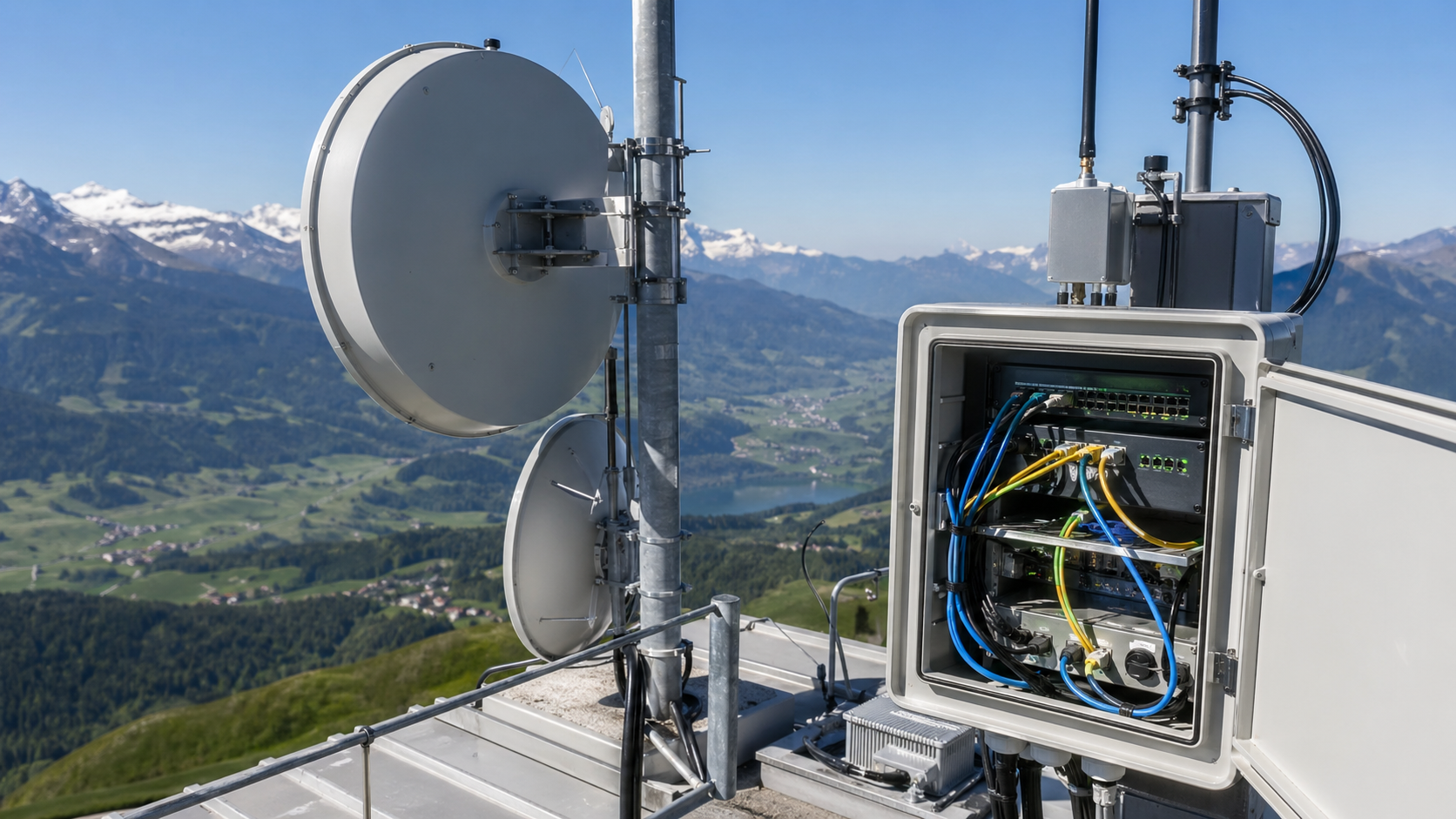
High-speed Amateur Radio Multimedia NETwork — an IP backbone operating at 5 GHz, developed by the amateur radio service, with around 30 Swiss sites and over 600 km of link routes.
Responsible (coordination): Swiss-ARTG, HB9RMW · Contact USKA: ✉ hamnet@uska.ch
HAMNET (High-speed Amateur Radio Multimedia NETwork) is a radio and cable-based IP network developed and operated by radio amateurs. It serves as a high-performance backbone for the existing infrastructure of the amateur radio service and enables IP connections. HAMNET has almost completely replaced the packet radio network that has been in existence since the 1980s. The network supports other amateur radio services such as EchoLink, WinLink2000, instant messaging, VoIP, DATV/IP-ATV and APRS; it also acts as a feeder network for the AREDN mesh radio network.
HAMNET is a network designed by radio amateurs that is separate from the internet; it primarily interconnects amateur stations in the 5 GHz band and facilitates the exchange of digital data. It also covers aspects of emergency radio operations (independence from the internet and mains power) as well as experimental operating procedures. TCP/IP is used as the transmission protocol (see also Wikipedia: HAMNET).
Objectives
- Exchange of digital data
- Support for emergency radio operations
- Promotion of innovative digital applications in amateur radio
- Development of open-source hardware and software for data transmission, modulation techniques and routing methods
- Replacement of the narrowband AFSK/FSK packet radio network
- Free user access to HAMNET with high bit rates
- Maintenance and utilisation of existing high-altitude sites for amateur radio
HAMNET — the Internet in amateur radio
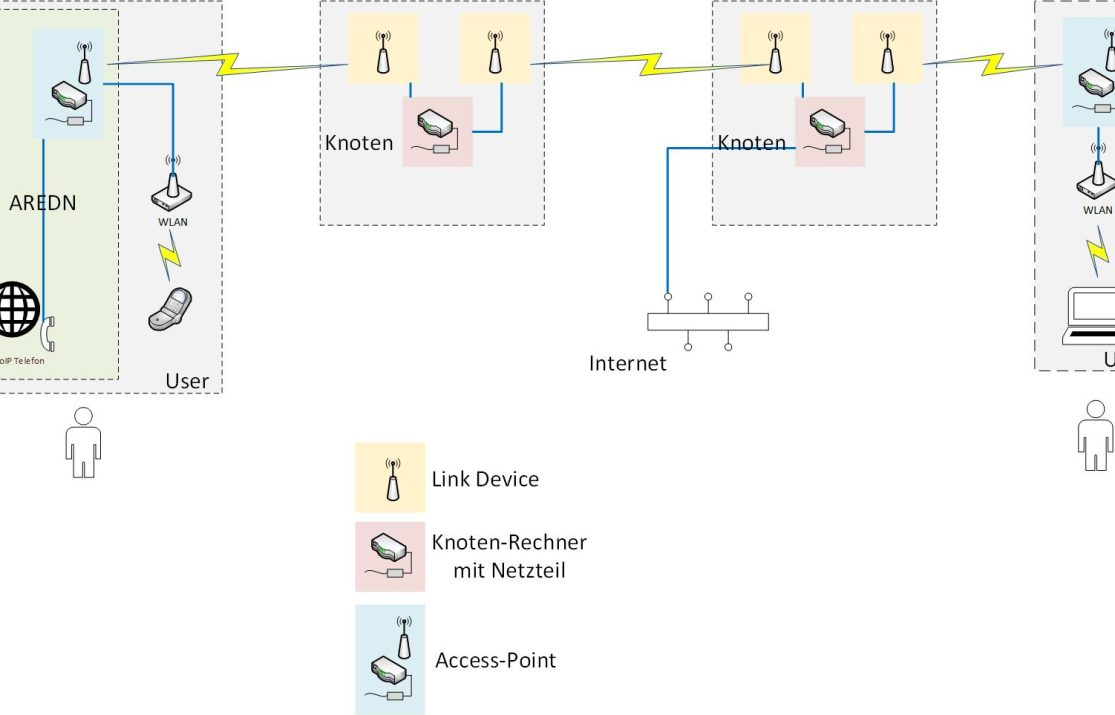
HAMNET is designed as a closed network; access from the internet is only possible via a gateway. The HF links are amateur radio installations which, in accordance with the Radio Regulations (Telecommunications Act), may only be operated and used by licensed radio amateurs. In a similar way to the internet, HAMNET connects radio amateurs with:
- SDR receivers and remote stations
- Web servers containing information about radio amateurs and technology
- Weather stations, webcams and cloud storage
- DX clusters, mailboxes, voice conferences, and information services for contest locations without internet access
- APRS, forwarding of APRS data to the APRS server (aprs.fi)
- Packet radio connections between PR nodes (replacing the 70 and 23 cm links)
- Connection of D-STAR and DMR repeaters to their respective networks
- EchoLink connections
- SSTV and ATV — transmission of digital image and audio data
- Voice-over-IP applications (SIP telephony, chat)
IP addresses — AMPRNet
Transmission takes place via TCP/IP. Network nodes are identified via IP addresses from the AMPRNet; the address range 44.0.0.0/8 is reserved exclusively for radio amateurs worldwide. The range 44.141.0.0/16 is allocated to Switzerland, and 44.149.0.0/16 to Germany.
Amateur Radio Digital Communications (ARDC) has decided to sell a quarter of these IP addresses to Amazon in order to safeguard its operations in the long term. This leaves the address blocks 44.0.0.0/9 and 44.128.0.0/10 for amateur radio — approximately 12.6 million IP addresses. Nationally, these are allocated by the IP coordination body; in Switzerland, this task is carried out by Swiss-ARTG.
Who can use HAMNET?
HAMNET is operated by clubs that set up sites with HAMNET nodes and establish radio links between these nodes. Users can either connect directly to a node site on 5 GHz or, if line-of-sight is not possible, access the network via VPN over the internet.
5 GHz user access
A clear line of sight between the user’s own antenna and the user access point is required. Obstacles within the Fresnel zone significantly weaken the signal. Tools such as Radio Mobile Online, Linktool, UISP Design Centre and the MikroTik calculator are available for calculating link distances.
Products from Ubiquiti and MikroTik are frequently used — Wi-Fi modules integrated into an antenna or reflector are of particular interest, as this eliminates coaxial attenuation. Conventional Wi-Fi technology (laptop Wi-Fi, home routers) is not suitable because the amateur radio frequencies and bandwidths cannot be adjusted on these devices.
Building your own equipment is also possible. Thomas Ries HB9XAR provides comprehensive documentation and the necessary software, including HAMNET driver extensions, on his website. The system is based on an energy-efficient ALIX board from PCEngines, one or more Atheros DCMA-82 Wi-Fi modules and the OpenWRT operating system.
VPN access via the Internet — HamCloud
Anyone without a line-of-sight connection to a HAMNET user access point can use the HamCloud VPN service — presented at the 2023 Three-Country Sysop Meeting in Engen by the IP coordinator DL, Jann Traschewski (DG8NGN). Swiss-ARTG recommends this service for Internet access to HAMNET. The former VPN service provided by the Digital Radio Club HB9DR has been discontinued by Swiss-ARTG.
Network operators: nodes and links
HAMNET consists of sites and contacts between these sites — both may only be operated by clubs and must be authorised by OFCOM, just like any other unmanned installation. Frequencies must be applied for via the frequency coordinator (email ✉ qrg@uska.ch). The following are required: the addresses of the technical manager and the president, the site details (name, CH1903+ coordinates, altitude above sea level), frequencies already allocated, and the planned date of commissioning.
IP addresses from the HAMNET range are allocated by the Swiss-ARTG IP co-ordinator (email ✉ ip-coordination@swiss-artg.ch). Please provide: the addresses of the technical manager and president, location (WGS 84 coordinates), size of the planned network (/24 to /27, /29 links), a brief project description for new projects, and planned commissioning date.
Typical hardware for a node
- Node computer (e.g. MikroTik RB3011 router)
- Power supply unit with multi-PoE adapter
- Link device (MikroTik QRT5 or Ubiquiti)
In principle, the node computer is ‘merely’ a network router; however, unlike domestic routers, it is freely programmable — and can be precisely tailored to the specific network configuration of the node. The link device is powered via PoE and includes the antenna and a mast mount. Cost: approx. 500–600 CHF for the first link, approx. 200 CHF for each additional link, plus rack and cabling. The frequencies for new link connections are determined by the frequency coordinator; the costs for the Link Device are usually borne by the two operators themselves.
How do I, as a user, connect to a node?
Contact the regional operator and ask for the connection parameters. You will need a 5 GHz access point — such as a Ubiquiti NanoStation 5AC Loco (airMAX ac, 450 Mbit+, weatherproof, ~10 km) or a MikroTik SXTsq Lite5. Cost: 50–100 CHF; Configure it using the operator’s connection parameters.
Technical details — frequencies and modulation
Link connections and access point connections are established in accordance with IEEE 802.11 a/n. The bandwidth is determined in consultation with the frequency coordinator — based on the current HAMNET band plan.
Documents and links
- [DE] HAMNET-Bestellprozess (PDF) — Ordering IP addresses, as at 12 November 2022
- [DE] HAMNET-Knoten-Konfiguration MikroTik Router (PDF) — as at 23 July 2020
- [DE] HAMNET-Link-Device-Konfiguration MikroTik (PDF) — As at 31 August 2022
- [DE] HamCloud — Angebotene Dienste in der HamCloud (PDF)
- Swiss-ARTG — IP Coordination Switzerland, HAMNET Deployment
- hamnetdb.net — Directory of all HAMNET sites in Europe
- hamnet.tuxworld.ch — ALIX image and Wi-Fi drivers by Thomas Ries HB9XAR
- AMPRNet Wiki — Global 44.x address space coordination
History
Since 2008/2009, the former packet radio network in Europe has been undergoing ongoing restructuring and being replaced by HAMNET links. In Switzerland, there are currently around 30 HAMNET sites in operation, with the total length of the linked routes exceeding 600 km. A directory of sites in Europe can be found in the HAMNET database. Swiss-ARTG is working alongside HB9AM (Chestenberg Interest Group) and the USKA sections in Lucerne (HB9LU) and Zug (HB9RF) to build up the Swiss network.
As early as the 1980s, the entire IP address block 44.0.0.0/8 was allocated to amateur radio — around 16 million addresses, making it one of the largest networks ever assigned. This ‘AMPRNet’ (44Net) is managed by the Amateur Radio Digital Communications (ARDC) Foundation and continues to form the address basis for HAMNET and other IP experiments in amateur radio to this day.