D-STAR
Digital Smart Technologies for Amateur Radio — a Japanese digital voice and data standard with call sign relay via a global relay network.
In the early 1990s, Japanese radio amateurs developed the D-STAR digital radio standard. It is tailored to the needs of the amateur radio service: D-STAR repeaters form a global digital radio network with automatic call sign relaying — connections between two or more radio amateurs are established via D-STAR repeaters without them needing to know which repeater their conversation partners are currently using.
Basics
The D-STAR network consists of a global network of relay stations that can be interconnected in a variety of ways. It transmits digital voice signals (DV — digital voice) as well as other digital data (DD — digital data). In addition to voice calls, D-STAR therefore also allows the transmission of location data or files. For practical reasons, routing between repeaters usually takes place via the internet; however, with the expansion of HAMNET, an increasing number of repeater operators are relying on data routing via HAMNET.
Contrary to the claim often made, D-STAR is not a commercial development by Icom, but rather a system developed in-house by Japanese radio amateurs. The standard was adopted by the Japan Amateur Radio League (JARL) between 1999 and 2001. In response to enquiries from the JARL, only Icom agreed to manufacture amateur radio transceivers to the D-STAR standard — in addition, there are numerous kits and DIY projects available for retrofitting existing FM radio transceivers.
Technical characteristics
Depending on the frequency and mode, the digital data stream is modulated onto the carrier using frequency shift keying (GMSK or 4-FSK) or phase modulation (QPSK). There are two modes:
- Digital Voice (DV) — 6 kHz bandwidth, half-duplex, data rate 4,800 bit/s (2,400 bit/s audio + 1,200 bit/s FEC + 1,200 bit/s short message). Voice signal compressed using the proprietary AMBE-2020 codec.
- Digital Data (DD) — 150 kHz bandwidth, simplex, data rate 128 kbit/s via Internet Protocol. Due to the bandwidth requirements, this mode can only be used in the 23 cm band and above.
- DV Fast Data Mode (since 2015) — 3,480 bit/s within the bandwidth of a DV signal, without an audio channel.
Codec 2 as an open alternative
The proprietary, patent-protected AMBE codec is also used in commercial applications (APCO P25, DMR, satellite phones). It was chosen for D-STAR because, in the 1990s, it was the only viable codec with a sufficiently low data rate. The Australian radio amateur David Rowe (VK5DGR) has created an open alternative in the form of the open-source Codec 2 — it is not compatible with AMBE, but opens up new possibilities for DIY projects.
Reflectors and networking
A D-STAR repeater consists of several modules: one module for each pair of input and output frequencies, usually distinguished by a suffix letter (A = 23 cm, B = 70 cm, C = 2 m). Several modules at a single location are interconnected via a controller to form a sector. Sectors can be linked via microwave links to form a zone; different zones communicate via gateways, which in turn are connected to HAMNET or the Internet.
Via the ircDDB network, the gateways exchange information about the call signs active on a repeater — the basis for automatic call sign forwarding. Furthermore, the DCS system allows several D-STAR repeaters to be interconnected to form a network, similar to a teleconference. No registration is required for purely local operation via a single repeater; however, some (primarily North American) repeaters still require the older US-TRUST system, which necessitates prior registration.
Today, interconnection is primarily achieved via reflectors — central servers to which repeaters and hotspots connect. Common systems include REF (DPlus protocol), XRF (DExtra) and DCS, as well as the multi-protocol XLX system, which combines all three protocols and operates without registration in the D-STAR Trust system.
Registration and data protection
D-STAR repeaters can be interconnected worldwide. Certain network services require that one’s own call sign be registered and activated. Registration is never required for purely local calls via a single D-STAR repeater — local operation works almost exactly the same as via an analogue FM repeater.
The majority of European D-STAR repeaters are connected to the ircDDB network, which offers call sign forwarding without registration. In addition, there is the older US-TRUST system, which is particularly widespread in North America and requires prior activation. Call sign relaying between ircDDB and US-TRUST repeaters is possible, but only works in the direction of US-TRUST if your own call sign is registered there. It is therefore well worth registering before travelling to a country where US-TRUST is predominantly used.
When using a D-STAR repeater, your own call sign is transmitted via the internet — this is technically necessary so that the ircDDB network can handle call sign forwarding.
DIY set-ups and hotspots
Icom is the only manufacturer to produce D-STAR devices as standard — but you no longer need an expensive radio transceiver to get started. As with DMR and C4FM, the simplest way is to set up an MMDVM hotspot using the Pi-Star software (or its successor, WPSD): A small add-on board on a Raspberry Pi becomes your personal D-STAR access point — the same device usually also supports DMR, C4FM, P25 and NXDN.
You can even do it without a radio transceiver at all by using an AMBE USB dongle (e.g. DVstick 30 or ThumbDV) on your computer: as the open Codec 2 is not compatible with AMBE, the dongle handles the voice encoding in hardware. Programmes such as BlueDV or DroidStar (also available for Android) connect directly to the D-STAR repeaters (REF/XRF/DCS) using this method.
Receiving signals alone is also a cost-effective option: D-STAR can be decoded using an RTL-SDR or DVB-T USB stick and the appropriate software — D-STAR Headers reads the protocol headers, whilst D-STAR Voice handles the voice data. Open-source projects such as the DVRPTR board and UP4DAR date back to the pioneering days; they have now largely been superseded by the MMDVM ecosystem.
D-STAR in Switzerland
In Switzerland, D-STAR repeaters are available on the 2 m and 70 cm bands, along with a few 23 cm stations — such as HB9EAS (Basel) or HB9RF (Zug). The repeaters are networked via reflectors:
- XLX229 — the central Swiss multi-protocol reflector, operated by Swiss-ARTG; many HB9 repeaters are connected to it by default. The XLX229 D module serves German-speaking Switzerland.
- REF098 — another reflector used in Switzerland (including HB9F on 70 cm).
Anyone without a repeater within range can — as with DMR and C4FM — access the D-STAR network via a Pi-Star hotspot and select the desired reflector directly from there. An up-to-date list of active D-STAR repeaters worldwide is published regularly — it helps with choosing a location whilst travelling and shows the network coverage in the region.
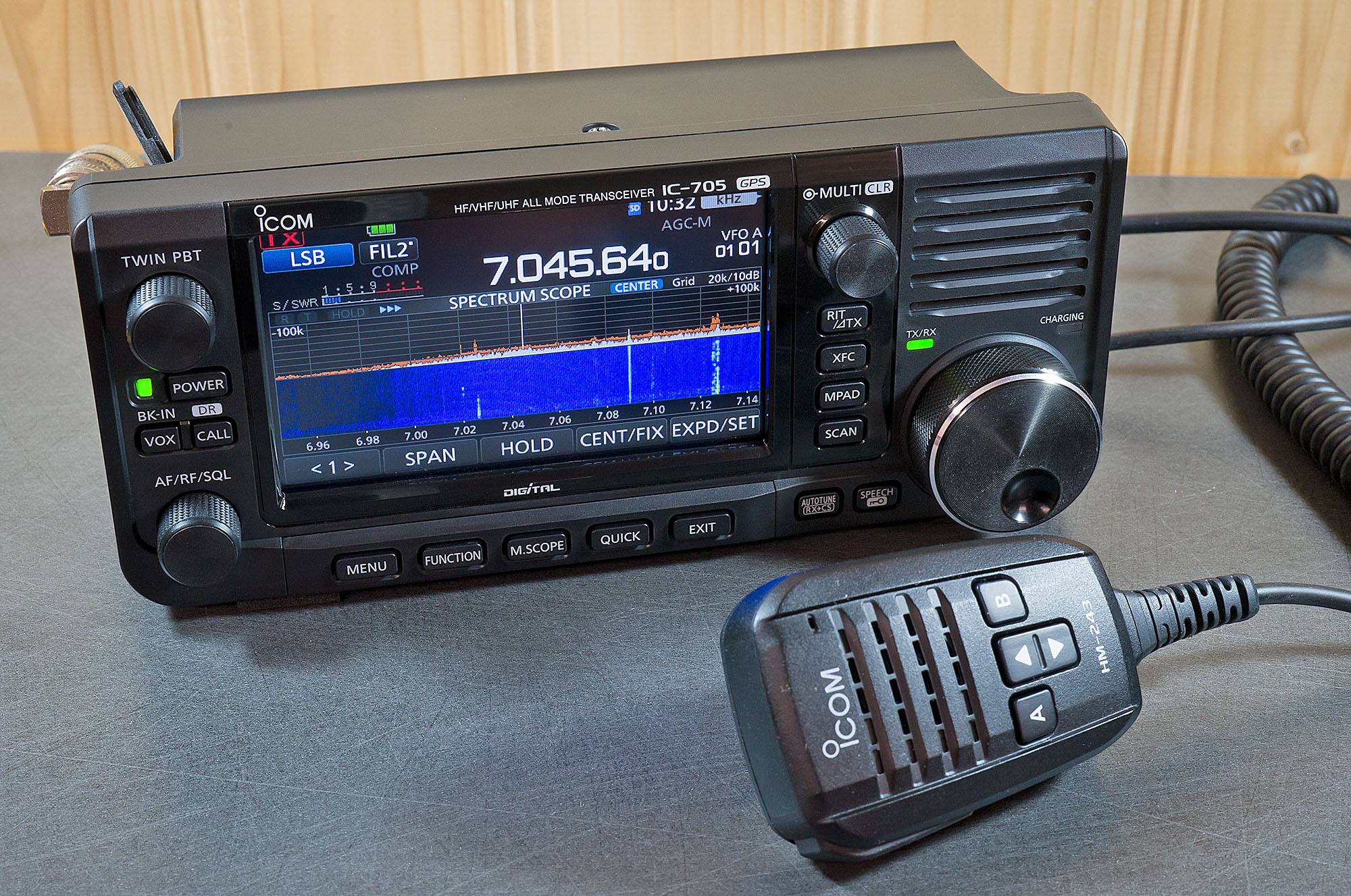
Cover image: Icom IC-705 — Photo by Batchman99, CC BY-SA 4.0.