CW / Morse code / Telegraphy
The oldest mode of operation in amateur radio — still very much alive today.
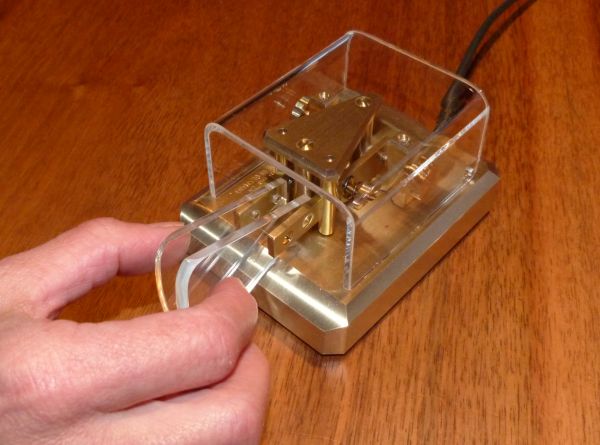
Telegraphy (from the Ancient Greek τῆλε tēle ‘far’ and γράφειν gráphein ‘to engrave, to write’ — meaning ‘writing from a distance’; also known as telegraphy or ‘CW’ = Continuous Wave) is the oldest mode of operation in amateur radio. It refers to the wireless transmission of information via a high-frequency carrier that is keyed or modulated in time with Morse code signals. The first experiments began over 100 years ago. Although Morse code signals are encoded and transmitted ‘digitally’, unlike the digital modes used in amateur radio, they are generally decoded by the radio amateurs themselves (A1A) — less commonly by machine (A1B).
The amateur bands are full of CW signals. Anyone who grasps the possibilities offered by this fascinating mode will find their amateur radio life greatly enriched. Learning telegraphy is easier than many people think — a few minutes’ daily practice will soon have you ready for the exam.
Preferred frequencies
The preferred CW bands on the shortwave amateur bands are: 1,810–1,838, 3,500–3,580, 7,000–7,040, 10,100–10,140, 14,000–14,070, 18,068–18,095, 21,000–21,070, 24,890–24,915 and 28,000–28,070 kHz. In addition, CW emissions are permitted on all sections of the amateur bands.
What does CW sound like?
Once learnt, never forgotten
: a demonstration of a typical CW QSO on shortwave.
Why do we use Morse code today?
Morse code is a hobby, a passion, a foreign language. Today, radio amateurs and a few commercial radio stations use Morse code.
Is there still a need for it?
Morse code is a mode of operation that makes it possible to establish connections worldwide using low power and small radio transceivers. If you want to operate with very little effort, there’s no getting round Morse code. As Morse code has to be learnt and not everyone has mastered this digital sign language, it is a sort of secret language.
What can be achieved?
Amongst radio amateurs, Morse code is one of many modes of operation. It allows connections to be made under conditions where voice radio is no longer possible.
Radio amateurs actively take part in various contests — one mode of operation in these contests is Morse code.
Morse code is like a foreign language. Once you have practised the basic skills, you can steadily increase your speed. This requires the determination to achieve specific goals.
Learning Morse code
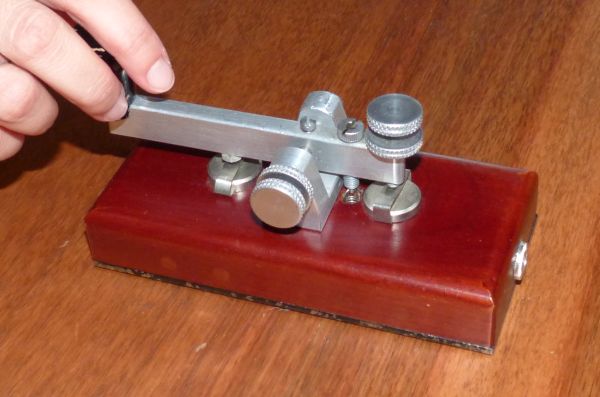
Learning Morse code — picking up and decoding Morse signals — is similar to learning a language. The letters are learnt individually and recognised as a melody. Every beginning is difficult. It takes determination and discipline to learn Morse code to the point where you can make contact on the air. But it’s fun.
It is possible to learn Morse code through self-study. In a Morse code course, the important foundations for receiving Morse signals are laid from the very first lesson. Anyone who picks up a bad habit at the start of their Morse code training will find it very difficult to break it — which is why it is preferable to learn Morse code on a course.
Once the basic set of signals has been learnt, the LCWO programme is an excellent way to further develop your Morse code skills.
Progress and practice
When it comes to Morse code, one thing is particularly true: no pain, no gain. Only those who regularly decode Morse signals themselves or transmit them can improve their skills. For radio amateurs, the FISTS Club’s frequencies are particularly well-suited — experienced Morse operators are on hand there to respond to general calls. They are happy to take the time to exchange tips with Morse partners or answer any questions asked. For experienced operators too, the LCWO programme is an excellent way to further develop Morse skills.
The HTC (Helvetia Telegraphy Club) recommends: Morse code is now only used in amateur radio — we need only focus on the requirements of this service. Radio amateurs must be able to respond and react immediately from memory on the frequency.
From a speed of 80 BpM, the HTC recommends starting memory training. Initially, you use short, easily recognisable words, abbreviations and Q-codes. Later, for practice, you use plain text with extended word intervals — you listen to the same text several times. The HB9HQX Morse 7 programme is the tool for this and is suitable for beginners, those returning to the hobby and advanced users.
Further reading
Two documents on the subject of Morse code that are well worth reading:
- [DE] Die Kunst der Radiotelegrafie — N0HFF (German translation)
- [DE] Zen und die Kunst der Funktelegrafie — IKØYGJ (German translation)