
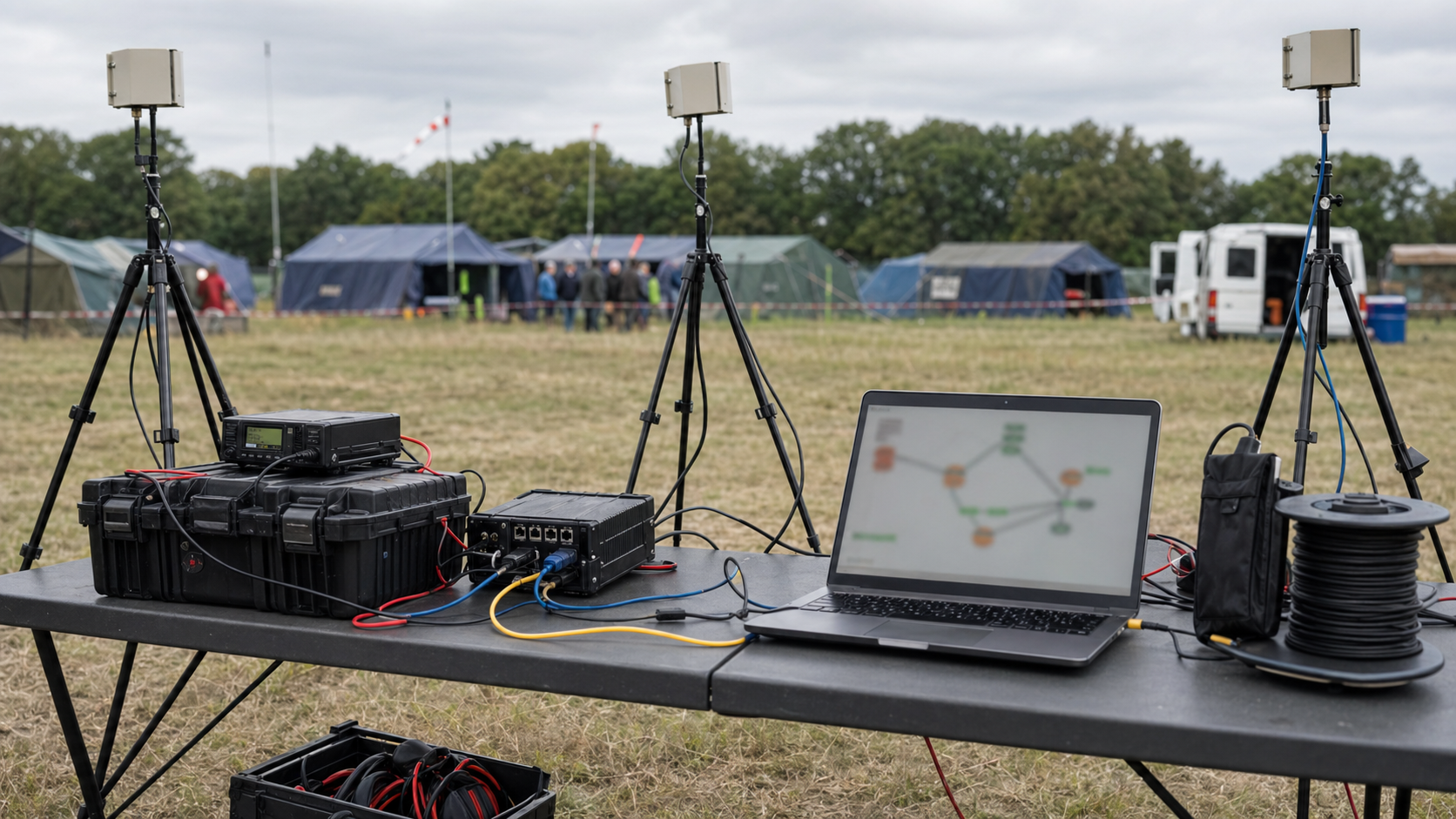
AREDN
Amateur Radio Emergency Data Network — a meshed TCP/IP radio net with speeds of up to 54 Mbps for emergency radio and data applications.
Amateur Radio Emergency Data Network (AREDN)
In a typical emergency radio scenario, the sender passes a message to a radio amateur, who records it in a radiogram. The message is then transmitted via VHF/UHF or shortwave using voice radio. In some cases, the handwritten form is transcribed a second time and forwarded by email (Pactor/Packet). In the worst-case scenario, the message sent by email has to be transcribed again so that it can be handed over.
What is AREDN? (pronounced ‘Arden’)
AREDN is a mesh radio network operating in the amateur bands. It is a high-speed network with data rates of up to 54 Mbps, designed to provide a TCP/IP medium when other network infrastructure has already failed. Although technically possible, it is not intended as an alternative to conventional internet access.
AREDN was written by the AREDN development team as a further development of the award-winning BBHN (Broadband Hamnet) firmware for Linux-based Wi-Fi and WISP (Wireless Internet Service Provider) devices. AREDN received an award from the ARRL in early August 2018. It replaces the devices’ manufacturer firmware with the following main components:
- OpenWRT — an open-source wireless routing framework on which custom developments can be built.
- Babel — a modern IP routing protocol for dynamic mesh and ad-hoc networks.
- Web-based configuration interface.
- Automatic device-specific TCP/IP configuration based on the device’s MAC address.
The primary aim of the project is to encourage radio amateurs to become part of the network, install the firmware on their devices and use it. The second aim is to develop standards and services for the use of this technology in emergency communications. AREDN functions like a local, wired home network — common services such as telephony, email, web servers, cameras, chat, etc. are easy to implement.
Difference from stationary HAMNET
Traditional HAMNET: Routes are planned; each link operates on a different frequency; and centralised allocation of IP addresses is required. During installation, care must be taken to ensure that the correct devices are designated as access points and stations.
With AREDN, all nodes operate on the same frequency. Only where there are several link routers at a single location may it be necessary to assign individual point-to-point links to a different frequency.
Advantage: Everyone can see everyone else
The network is designed as an ad-hoc network — anyone can connect to anyone else. Sophisticated logic within Babel establishes connections between nodes and assesses the quality of the connection (“Cost of Link”). Transmitted packets always take the “most favourable” route; if a section of the link fails, an alternative route is selected.
For emergency radio, this means: rapid set-up on a standard frequency — set and forget. Plug it in, set it up, and the rest happens automatically. If services such as VoIP telephony or a web/email server are running on a node, these are automatically advertised on the network and are accessible network-wide. Ring structures and cross-connections are easy to implement.
For example, the secondary radiation from one node is sufficient to connect to a second node — even one 50 metres away — even though both reflectors are pointing away from each other towards other remote stations.
Source: DARC — emergency radio / AREDN.
AREDN in Switzerland
In Switzerland, AREDN is primarily being established as an emergency radio network — a data backbone independent of the internet and the electricity grid, which continues to operate even in the event of a blackout or a telecommunications failure. It is supported by regional groups and individual volunteers; in the Solothurn/Bern area, the Solothurn Radio and Technology Association (HB9FTS) and other sections and relay groups are among those involved.
The main node is located on the Weissenstein and is operated by the Solothurn Radio and Technology Association (HB9FTS). As an elevated site, Solothurn’s local mountain offers sweeping views across the Mittelland and forms the central backbone node through which the region’s AREDN stations are interconnected. Such elevated locations are key to connecting user access points over long distances to form a coherent mesh network — and provide an ideal basis for field trials and emergency radio demonstrations.
A second, independent AREDN network exists in Central Switzerland — in the cantons of Uri, Schwyz and Unterwalden. It is operated by the USKA Uri-Schwyz Section (HB9CF), which has a strong emergency radio community and collaborates with the cantonal authorities in the event of a crisis (power cut, disasters). The nodes are situated at well-located elevated sites in Central Switzerland — including Föhnenschwand (Schwyz), Rüti (Morschach), Alp Weid (Seelisberg) and Haldi (Schattdorf).
In Switzerland, radio communications take place predominantly in the 5 GHz band (reserved for radio amateurs, as with HAMNET), and to some extent also on 2.4 GHz. Standard commercial Wi-Fi microwave links (e.g. Ubiquiti NanoStation or Rocket) with AREDN firmware are sufficient – no hardware modifications are required, and prices start from around 80 Swiss francs. An introduction, videos and local contacts can be found via the links below.
Further links
- arednmesh.org — official AREDN project
- hb9fts.ch/aredn/ — AREDN in Switzerland (HB9FTS)
- [DE] Einführung in AREDN — Presentation by HB9BLA, HamWebinar 2023 (PDF)
Videos
▶ AREDN HamWebinar — Part 1
HB9BLA, 2023 — Introduction to AREDN
▶ AREDN HamWebinar — Part 2
HB9BLA, 2023 — AREDN on Proxmox
▶ AREDN HamWebinar — Part 3
HB9BLA, 2023 — Making direct calls with AREDN

▶ AREDN — Introductory
video by HB9BLA, USKA committee member for “New Technologies”