APRS
Automatic Packet Reporting System — short data packets transmitted via radio show in real time on a map who and what is where: positions, weather, messages and telemetry.
APRS (Automatic Packet Reporting System) is a digital radio net for short data packets. Stations continuously transmit their position, weather data, short messages or telemetry on a shared frequency; anyone within range receives them directly, and they are displayed on a map worldwide via the internet.
How APRS works
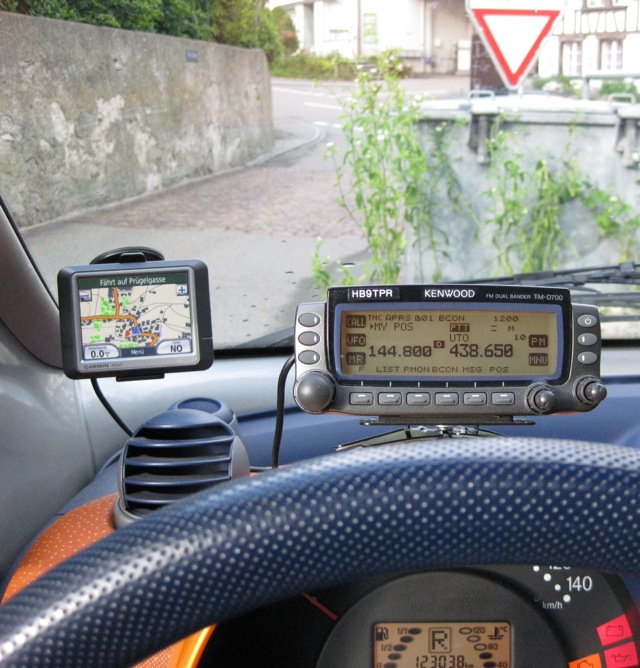
An APRS device transmits a small data packet at short intervals (based on the AX.25 packet radio protocol) — in Europe on the shared frequency of 144.800 MHz. For mobile stations, a GPS receiver provides the position. All APRS stations within range receive the packet immediately.
To ensure the packets reach their destination even over longer distances, digipeaters (digital repeaters) automatically relay them. iGates (Internet gateways) feed the received packets into the global APRS Internet network (APRS-IS) — where they can be tracked live on maps such as aprs.fi, even without your own radio equipment.
What you can do with APRS
APRS is much more than just a position tracker. Typical uses include:
- Tracking vehicles, hikers, weather balloons or a Field Day location live on a map
- Exchanging short messages and bulletins between stations — without needing a mobile network
- Operating weather stations that report temperature, wind and rainfall
- Transmitting telemetry and sensor data
- Marking objects and key locations (e.g. emergency meeting points or repeaters)
- Send emergency and location messages (Emergency Bake)
LoRa-APRS
A modern, cost-effective option is LoRa-APRS: instead of the traditional 2-metre packet technology, it uses energy-efficient LoRa radio technology on 433.775 MHz (70-cm band). A small ESP32 board with GPS (e.g. LILYGO T-Beam or Heltec), costing just a few francs, serves as the tracker; despite low transmit power, LoRa enables long ranges. LoRa-iGates feed the positions into the same APRS network — so on aprs.fi, LoRa stations appear on an equal footing alongside the traditional ones. In Europe, LoRa-APRS coverage is now extensive. Find out more at: lora-aprs.org.
Get involved
To simply track locations, all you need is aprs.fi in your browser — no call sign is required. To transmit, you can use radio transceivers with built-in APRS (such as those from Kenwood or Yaesu, usually with GPS), a simple tracker on a 2-metre radio transceiver, or a LoRa-APRS board. Emissions require a valid amateur radio call sign.
History
APRS was developed from the 1980s onwards by Bob Bruninga (WB4APR) at the US Naval Academy — originally to see in real time where stations and events were located. This idea grew into a global network with tens of thousands of participants. Bruninga, the ‘father of APRS’, passed away in 2022; his network continues to operate — and is even expanding anew with LoRa-APRS.