
FT8
A digital mode operating in 15-second intervals with a bandwidth of just 50 Hz — low power, simple antennas, long ranges.
FT8 is a digital mode used in amateur radio for wireless communication. It is mainly used on shortwave, but in principle can also be used on all other frequencies. Radio amateurs have developed the WSJT-X programme, which enables operation in this mode.
FT8 was publicly unveiled in 2017 by Joe Taylor (K1JT) and Steve Franke (K9AN) and quickly gained popularity.
It is characterised by the rapid transmission of data within a 15-second time slot, whilst requiring a low signal-to-noise ratio (SNR). The modulation uses a very narrow bandwidth of 50 Hz (by way of comparison: voice transmission requires at least 2.7 kHz). This makes it possible to cover very long distances using low power and simple antennas.
Technical features
FT8 uses an eight-level frequency-shift keying (8-GFSK): eight tones spaced 6.25 Hz apart together cover a total of around 50 Hz. 6.25 symbols are transmitted per second, each carrying 3 bits.
An emission lasts 12.6 seconds within the 15-second time slot and consists of 79 symbols; of these, 58 symbols carry payload data.
Signals with a signal-to-noise ratio of up to approximately −21 dB (relative to a bandwidth of 2,500 Hz) are decoded — well below the hearing threshold. This requires the time at both stations to be accurate to within approximately one second (via Internet time synchronisation/NTP or GPS), as the transmitters and receivers are fixed at 15-second intervals.
Waterfall diagram
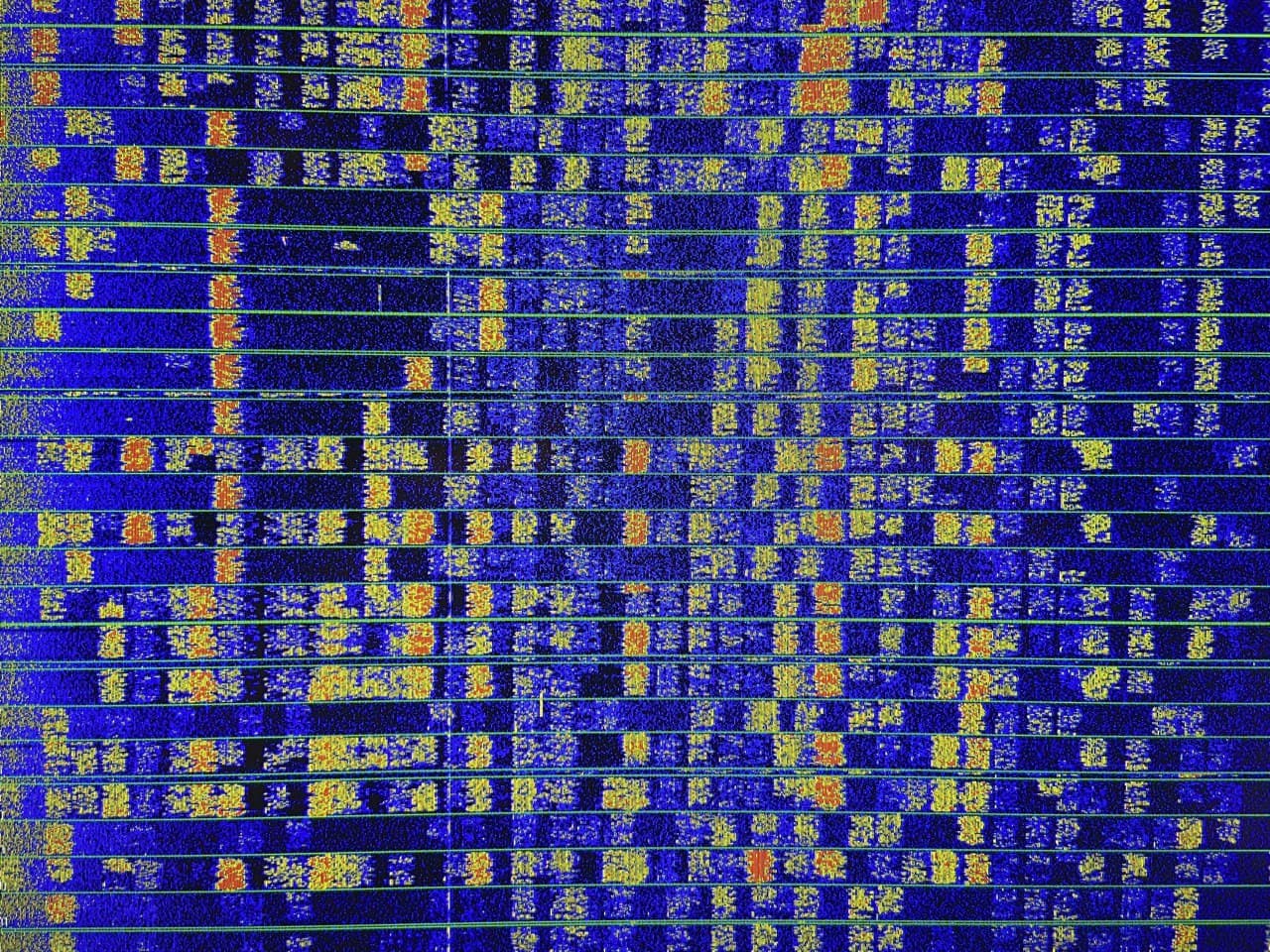
Waterfall diagrams show the activity within a specific frequency range. They are integrated into many modern devices and are also used in software for digital modes and in SDR receivers. Here, 50 parallel FT8 transmissions, each with a bandwidth of 50 Hz, can be seen within a frequency range of approximately 2.5 kHz. The duration of a transmission (vertical axis) is 15 seconds and is synchronised with a time standard (e.g. GPS). Decoding with WSJT-X.
Sequence of a QSO
FT8 contacts follow a fixed pattern: the stations transmit alternately at 15-second intervals (one in the even time slots, the other in the odd ones). Only short, standardised messages are transmitted — call sign, locator (Maidenhead), signal report in dB, and the acknowledgements RRR, RR73 and 73.
A complete QSO consists of just a few rounds and lasts around one minute. WSJT-X handles most of the sequence automatically if desired (auto-sequencing) — simply click on the desired station in the waterfall display. FT8 is not intended for longer, free-form conversations (ragchew).
Faster variants: FT4 and FT2
- FT4 — introduced in 2019 by Joe Taylor (K1JT) and Steve Franke (K9AN) as a contest variant and part of WSJT-X. Pass interval 7.5 s, bandwidth around 90 Hz. Slightly less sensitive than FT8, but twice as fast.
- FT2 — an experimental, even faster mode developed by the Italian radio amateur Martino Merola (IU8LMC). It uses the same codec as FT8/FT4 (77-bit message, LDPC 174/91, 8-GFSK), but shortens the interval to around 3.8 s (roughly four times as fast as FT8). With a bandwidth of ~150 Hz and lower sensitivity (≈ −12 dB), it is designed for contest and pile-up situations with strong signals, not for operation with weak signals.
Connection to the transceiver
For FT8, the computer sends audio signals to the transmitter and receives the audio from the receiver; in addition, the PC must activate the transmitter (PTT) and, ideally, read and control the frequency (CAT). There are two ways to do this:
- Via an interface (Link device): A sound card interface (e.g. SignaLink USB, a digimode interface or a homemade setup with audio transformers and optocouplers) is connected between the PC’s sound card and the transceiver’s data/ACC socket. It provides galvanic isolation between the two devices (preventing ground loops) and activates the transmitter via its own PTT line or via a built-in audio VOX. This is necessary for older radio transceivers without USB.
- Directly via USB: Modern transceivers (e.g. Icom IC-7300 / IC-705, Yaesu FT-991A / FTDX10, Kenwood TS-590SG) already come equipped with a USB sound card and CAT control. A single USB cable transmits transmit and receive audio, PTT and frequency control — without the need for an additional interface.
In both cases, you need to set the correct sound card (input and output) and the PTT method (CAT, RTS/DTR or VOX) in the software. Important: keep the audio level low enough that the ALC does not activate — otherwise, spatter will occur. Reduce the transmit power due to continuous-wave operation (refer to the manual).
Software
The standard programme is the open-source, free WSJT-X (Joe Taylor K1JT and team) for Windows, Linux and macOS; in addition to FT8, it also supports FT4, JT65, JT9, WSPR and other modes. Common alternatives with extended functionality include JTDX and WSJT-Z.
For the USKA Christmas Contest (Digital), there is a Swiss adaptation, WSJT-Swiss: this extends FT8 to include the exchange of the canton code (e.g. ZH, BE) and the call ‘CQ XMAS’. These Swiss contest messages are only correctly decoded by WSJT-Swiss.