DMR
Digital Mobile Radio — ETSI-standardised digital modulation for voice and data, with two time slots per channel and global interconnection via Brandmeister, IPSC2 and DMR-MARC.
Since 2006, the DMR transmission mode has been used for digital mobile radio in non-public radio nets — primarily in private radio nets. DMR relay stations can be networked with one another, thereby covering large areas. As DMR devices are available at affordable prices, they are also used in amateur radio.
Basics
DMR stands for Digital Mobile Radio. In this context, ‘mobile radio’ does not refer to the public mobile telephone network, but to all non-public mobile radio applications: digital radio nets for voice and data transmission within a business and between geographically remote branch offices.
DMR is defined by ETSI in the ETSI TS 102 361 series of standards (Parts 1–4, first edition 2005); the radio transceivers themselves comply with the EN 300 113 equipment standard. The standard describes several variants:
- DMR Tier I — generally allocated, available to anyone without registration (digital variant of analogue PMR radio, DMR446).
- DMR Tier II — relevant for radio amateurs and commercial private mobile radio (repeater operation with fixed frequencies).
- DMR Tier III — a fully-fledged trunked radio network with site controllers; not relevant to the amateur radio service.
Technical characteristics
A DMR signal occupies a channel with a bandwidth of 12.5 kHz. The digital data stream is modulated using 4-FSK at 4,800 symbols per second — two bits per symbol, giving a gross data rate of 9,600 bits per second.
Time division multiple access (TDMA) divides the channel into two time slots — the data for each of the two slots is transmitted approximately every 30 ms. In amateur radio, half-duplex operation is used, so that the two slots can carry two independent voice channels. After error correction and protocol overhead, approximately 2,450 bits per second are available per slot for compressed voice; the proprietary AMBE+2 codec is used, as agreed upon by the manufacturers united within the DMR Association.
If two repeaters at exposed locations are operating on the same frequency, they can be selected via the Colour Code — a 4-bit number included in every emission (16 possible values, comparable to CTCSS/DCS in the analogue domain). In amateur radio, this technology is used sparingly; as a rule, ColorCode 1 is active. If a DMR repeater cannot be tuned in, an incorrect ColorCode is a common cause.
Time slots and talkgroups
Thanks to time division multiple access (TDMA), the DMR channel carries two simultaneous, independent time slots — TS1 and TS2 — on the same frequency; a repeater can thus handle two conversations in parallel.
A talk group (TG) is the associated group address: an emission is only relayed to those repeaters and hotspots that have the same TG enabled. Via servers on the internet, repeaters in any region can thus be linked together — from local networks to global groups. Which time slot is used with which talk group is purely a matter of operational agreement.
There are two types of talk groups on a repeater: fixed (static) TGs are permanently assigned to a time slot by the repeater operator and can always be heard without anyone having to transmit first. Temporary (dynamic) TGs are activated by the user themselves at the press of a button (PTT); they remain active for a few minutes after the last local traffic (around 15 minutes on Brandmeister) and then disconnect automatically. The next section shows which talk groups are commonly used in Switzerland.
Repeater networking
Radio amateurs connect their DMR repeaters via servers on the internet and within HAMNET to form large networks. Today, Brandmeister is by far the most important amateur radio DMR network. The older networks — DMR-MARC (based on the proprietary cBridge software) and the IPSC2-based DMRplus servers — have almost entirely migrated to Brandmeister in recent years; further development of the IPSC2 software was discontinued in 2024.
Brandmeister (brandmeister.network) does not use the older reflector concept and instead operates with talkgroups and clusters: a talkgroup is activated on the desired time slot at the press of a button (PTT) and remains connected to the repeater for several minutes afterwards. Each station manages its own settings via the self-service portal (SelfCare). Many talkgroups are linked to other systems such as D-STAR, Yaesu Fusion (YSF) or XLX reflectors.
In Switzerland, some talkgroups serve as call channels; the actual QSO then takes place on a tactical group:
- TG228 — the national call talkgroup, permanently active on all Swiss repeaters.
- TG2280–2284 — the regional or language-specific call talkgroups: TG2280 German-speaking Switzerland, TG2281 French-speaking Switzerland, TG2282 Valais, TG2283 Bern/Solothurn, TG2284 Basel.
- For the actual QSO, you switch from the call sign talk group to one of the four tactical talk groups TG22801, TG22802, TG22803 and TG22804 (UA 1–4, on TS1), so that the call channels remain free.
As a rule of thumb, international contacts, the national TG228 and the user talkgroups run on time slot 1 (TS1); regional and local traffic remains on time slot 2 (TS2).
Hotspots and Pi-Star
Anyone without a DMR repeater within range can access the network via a personal hotspot. A hotspot is a tiny simplex or duplex transceiver with an MMDVM (Multi-Mode Digital Voice Modem) that relays the digital radio signal directly to Brandmeister via an internet connection — effectively a private mini-repeater with a range of just a few metres. This means you can join global talkgroups from home, even with low power output.
The most widely used control software is the Pi-Star project — a ready-made Raspberry Pi image that supports DMR as well as D-STAR, Yaesu Fusion (YSF), P25 and NXDN, and can be easily set up via a web interface. WPSD (W0CHP-PiStar-Dashboard) has established itself as an actively maintained successor. Both run on a Raspberry Pi (often a Pi Zero W) with an MMDVM add-on board or a DVMega module. As an alternative, there are standalone hotspots with their own firmware that operate entirely without a Raspberry Pi or Pi-Star — such as the SharkRF openSPOT.
Registration and data protection
DMR was developed for professional radio communications — the unique identification of each participant is based on numbers, not call signs. As amateur radio service extensions (such as Talker Alias, amongst others) cannot replace this uniqueness, international coordination is necessary. The numbers are based on the Mobile Country Code: 228 is allocated to Switzerland. Repeaters are assigned six-digit numbers, whilst individual and club stations are assigned seven-digit numbers; no numbers are assigned for training call signs.
Applications for the number are made via radioid.net. A copy of the amateur radio licence (OFCOM) must be submitted with the application — applications will not be processed without proof of a licence. Applications are reviewed on a voluntary basis by radio amateurs; the data submitted is treated confidentially.
During a radio operation using a DMR repeater, the assigned number (and thus, indirectly, the call sign) is transmitted via the internet — this is technically necessary for routing between the networked repeaters.
DMR in Switzerland
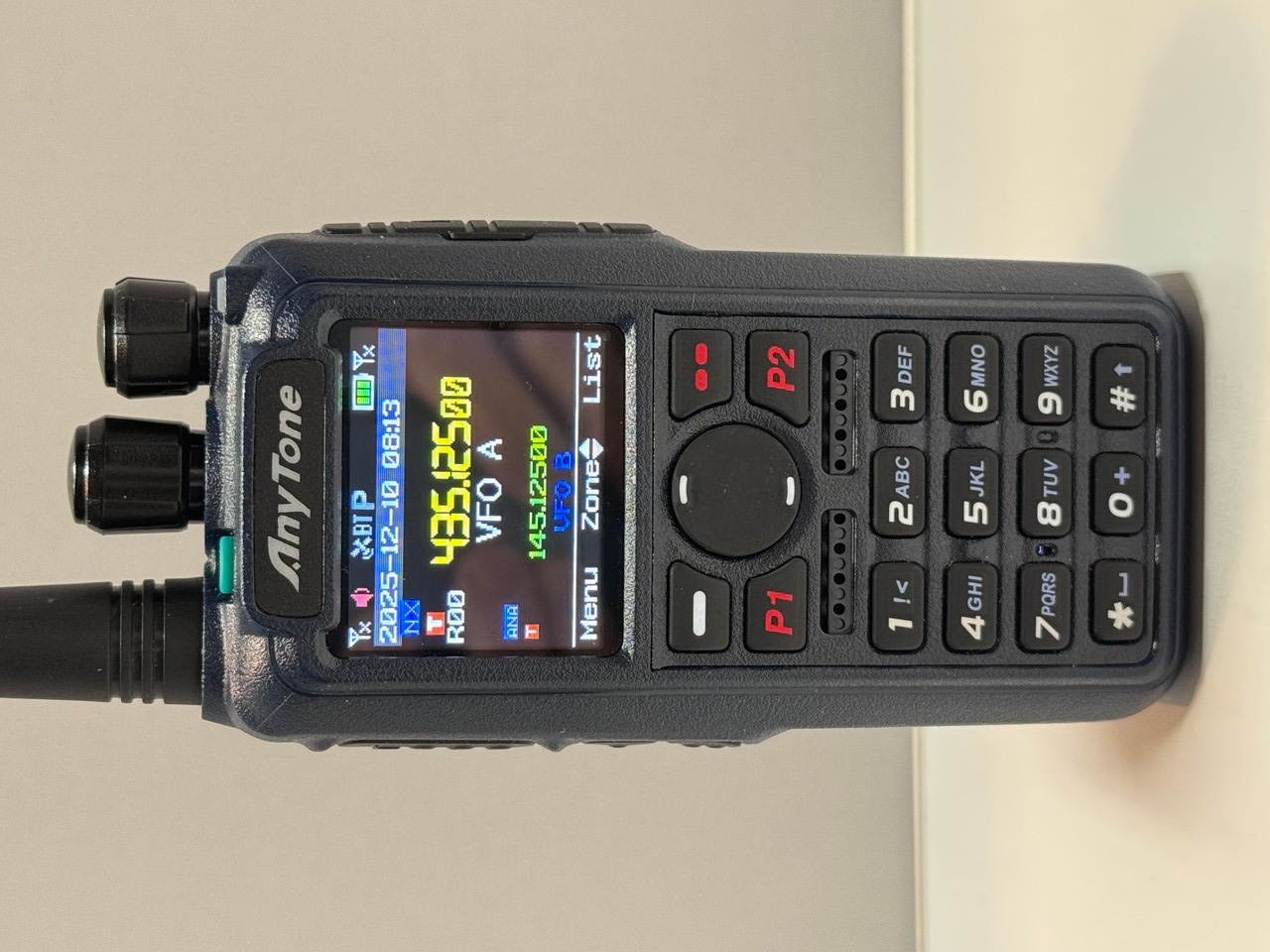
In Switzerland, DMR is predominantly networked via the fire service network. Swiss DMR IDs begin with 228; the national talk group is TG228. In terms of equipment, AnyTone (e.g. AT-D878UV) dominates — the brand is widely used in Swiss amateur radio. An overview of the DMR repeaters active in Switzerland is continuously updated.