
Image transmission
Images in amateur radio — SSTV and digital methods, amateur television (ATV/DATV) and the reception of SSTV images from the International Space Station (ISS).
In amateur radio, both still and moving images can be transmitted — both analogue and digital, from shortwave through VHF to geostationary satellites. The following overview presents the methods commonly used today; the final chapter summarises their historical development.
SSTV — Slow Scan Television
SSTV (Slow Scan Television) is by far the most widespread imaging method in amateur radio. A still image is converted line by line into audio frequencies and transmitted like a voice signal in an SSB channel (approximately 3 kHz bandwidth) — the pitch represents brightness or colour. Depending on the mode, an image takes around 8 to 120 seconds to transmit.
The transmitter and receiver must be set to the same transmission mode. Commonly used are the colour modes Martin (M1/M2), Scottie (S1/S2/DX), Robot (36/72) and the higher-resolution PD modes (PD90/120/180). Martin 1 is considered a good compromise between transmission time and resolution.
All you need to get started is an SSB transceiver with a computer and sound card (connected in the same way as for FT8) — or a smartphone that simply records the tones via the microphone. Common programmes include MMSSTV (Windows), QSSTV (Linux), Black Cat SSTV (macOS/iOS) and Robot36 (Android). Shortwave calling frequencies (USB): 3,730, 7,165, 14,230 (the best known), 21,340 and 28,680 kHz. A comprehensive, free reference work is the SSTV Handbook by OK2MNM.
SSTV from the International Space Station (ISS)
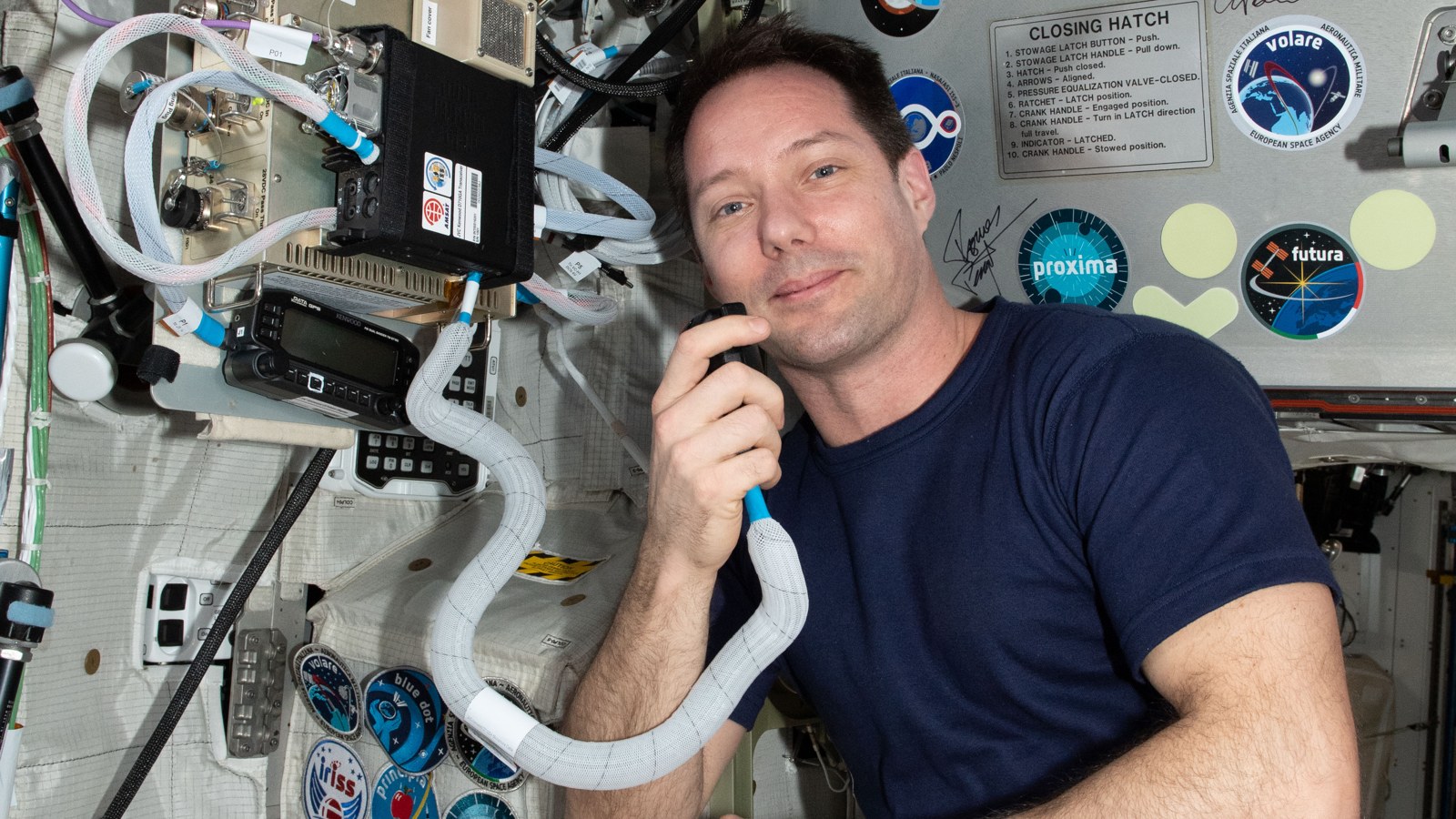
SSTV images are also transmitted regularly from the International Space Station (ISS) — as part of the ARISS (Amateur Radio on the ISS) programme. Emissions take place on special occasions on 145.800 MHz FM (±3.5 kHz Doppler shift) in PD120 mode, typically at a rate of 2 minutes’ image followed by a 2-minute pause. To receive the transmissions, all you need is a simple 2-metre handheld radio transceiver (or an SDR) and an SSTV app on your mobile phone — simply hold the screen up to the radio transceiver. Received images can be uploaded to the ARISS gallery, and participants receive a certificate. ARISS announces the dates.
Digital SSTV (HamDRM)
With digital image transmission, the image file itself is transmitted rather than point by point — using error correction and an OFDM modem comprising many parallel subcarriers (related to Digital Radio Mondiale, hence HamDRM). This ensures that images arrive without distorted pixels even in poor conditions, and the resolution can be freely selected. Commonly used software includes the Windows programme EasyPal (images in JPEG2000 format) and, on Linux, QSSTV, which also supports HamDRM; KG-STV is a text-based imaging method. Calling frequencies (USB): 3,733, 7,173, 14,233 and 21,340 kHz.
FAX and weather fax
Facsimile transmission (HF FAX) scans a document line by line — the oldest imaging method in radio. Active transmitters play hardly any role in amateur radio; by contrast, the reception of weather fax (Wefax) is widespread: Weather services transmit weather charts on shortwave, which can be decoded using the same sound card software as SSTV. FAX and SSTV share many calling frequencies (such as 14,230 kHz) — the transmission mode and standard should therefore be announced before the emission.
ATV and DATV — Amateur Radio Television
Amateur radio television is used for moving images. Analogue ATV transmits live video with sound, exclusively above 430 MHz — the bandwidth required for a television picture cannot be accommodated on shortwave. It is used, for example, for Rundspruchs, lectures and meetings; the terrestrial range is a few tens of kilometres and depends heavily on propagation conditions.
With DATV (Digital ATV), the picture and sound are digitised before transmission and relayed in the same way as satellite television (DVB-S/S2) — the signal becomes narrower and more resistant to interference. DATV is of great significance via the geostationary amateur radio satellite QO-100 (Es’hail-2): its broadband transponder enables DATV connections from Brazil to Thailand around the clock. Digital SSTV images (EasyPal, KG-STV) are also regularly received via this satellite.
History
Image transmission is almost as old as telegraphy: as early as 1843, Alexander Bain proposed a ‘copy telegraph’; in the 1920s, RCA, Siemens and Rudolf Hell developed image telegraphy (FAX). SSTV originated in the USA in the late 1950s; the first German experiments began in 1972, initially using afterglow tubes from radar stocks. The German radio amateur Volker Wraase (DL2RZ) replaced the initial frame-sequential colour method with a line-sequential one — the basis of today’s standard. The British amateurs Eddie ‘Scottie’ Murphy (GM3SBC) and Martin Emmerson (G3OQD) made the transmission more resistant to interference with their modes, which are still named after them today. On the history of image telegraphy: technikum29.
Cover image: Thomas Pesquet at the ARISS amateur station on the ISS. Photo: NASA (public domain).