
SDR
Software-Defined Radio — radio transceivers in which signal processing is carried out by software. This technology is now found in almost every modern transceiver, in low-cost USB sticks, in internet receivers and in the QO-100 satellite.
Software-Defined Radio (SDR) refers to radio receivers and transmitters in which as much of the signal processing as possible — filtering, selection, demodulation — takes place not in fixed analogue hardware, but in software. This means that the modulation mode, bandwidth or decoding method can be changed using software alone, without the need for a soldering iron. What was a field of experimentation 20 years ago is now part of everyday life: almost every modern amateur radio transceiver is, at its core, an SDR.
How an SDR works
Ideally, an SDR receiver consists only of an antenna, an analogue-to-digital converter and a computer: the antenna signal is digitised, and the rest is handled by software. In practice, there is some analogue circuitry upstream (filters, preamplifiers). Common approaches include direct sampling (where the signal is digitised immediately) and the direct-conversion receiver using the I/Q method. At the heart of both approaches is the I/Q signal — two signal branches shifted by 90°, from which the software reconstructs the frequency, phase and modulation.
Modern transceivers — the SDR within the unit
Alongside the widely used Icom IC-7300, devices such as the IC-705, Yaesu FTDX10, Kenwood TS-890 and the FlexRadio series are software-based. A distinctive feature is the waterfall display (panadapter): you can see the entire band at a glance and click directly on a station. Mode, filter bandwidth and noise reduction are purely software settings — and firmware updates bring new features without the need for new hardware.
RTL-SDR — the affordable way in
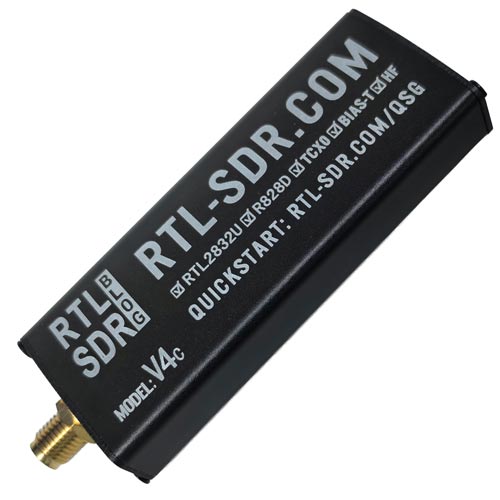
The cheapest way into SDR is via an RTL-SDR: originally DVB-T TV sticks featuring the Realtek RTL2832U chipset, which can be converted into a broadband receiver using an alternative driver (covering approximately 24 MHz to 1.7 GHz, depending on the tuner) — for around 30 francs. These can be used to receive amateur radio bands, aeronautical radio, weather satellites or ADS-B position data from aircraft. For shortwave, you’ll need a converter or a stick that’s directly RF-capable (RTL-SDR Blog V3/V4); the ‘Software’ section lists the appropriate reception software.
WebSDR — receivers on the internet
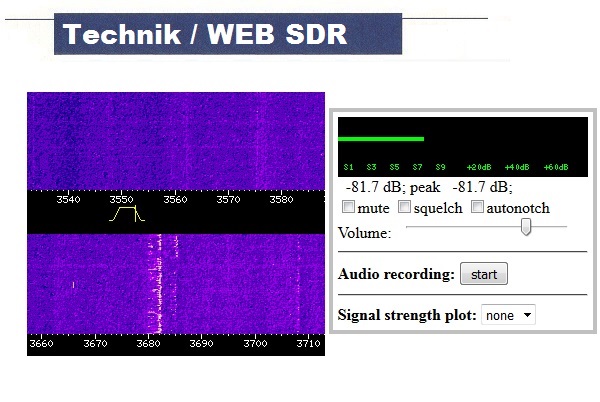
You don’t even need your own antenna: via a WebSDR or KiwiSDR, you can listen to other people’s receivers worldwide directly in your browser — handy for monitoring your own emission, checking propagation or listening without local interference. In Switzerland, receivers from HB9RYZ (Rigi Scheidegg, 1,660 m), the Schlössli Radio Club HB9RE, HB9HEH (Hasenberg) and HB9CWK (near Bern) are among those open to the public. HB9RE maintains a well-organised list of Swiss stations; global directories include websdr.org and the KiwiSDR map.
The amateur radio satellite QO-100 can be listened to live on the BATC/AMSAT-UK WebSDR – both the narrowband transponder (SSB, CW, digital modes) and the wideband transponder with DATV television service.
Software and open-source projects
There are numerous programmes available for receiving, tuning and displaying the waterfall. Widely used are SDR# (SDRSharp) and the modern, cross-platform SDR++; also SDR Console (with powerful satellite and multi-receiver functions), HDSDR on Windows and GQRX on Linux/macOS.
With rtl_433, you can decode the swarm of small wireless sensors in the 433/868 MHz ISM band — weather stations, tyre pressure sensors (TPMS), doorbells, smart sockets and much more. A simple RTL-SDR dongle is all it takes to reveal everything that’s transmitting around the house.
If you want to build your own radio systems, use GNU Radio, a modular toolkit of signal processing blocks; OpenWebRX is a browser-based multi-user receiver.
And for the truly innovative: Claude Code or Codex CLI will write entire Python programmes for you for an RTL-SDR dongle, which will extract exactly what you’ve always wanted from the spectrum. Brilliant!