FM
Frequency modulation — the preferred mode of voice communication above 50 MHz: narrowband, resistant to interference and the backbone of the Swiss relay network.
In the amateur radio service, frequency modulation (FM) is mainly (though not exclusively) used for voice communications on frequencies above 50 MHz. FM is the preferred transmission mode, particularly for short-range communication and via repeaters. In amateur radio, FM is operated in the F3E modulation mode — voice communication using a single-channel analogue signal on a frequency-modulated carrier.
Basics
In frequency modulation, the frequency of a constant carrier is reduced or increased by the amplitude of the baseband signal (e.g. speech). The FM signal therefore fluctuates in frequency around the carrier frequency. The maximum deviation is called the frequency deviation, or simply ‘deviation’ — it is determined by the modulator’s circuitry. The ratio of the frequency deviation to the maximum baseband frequency is called the modulation index.
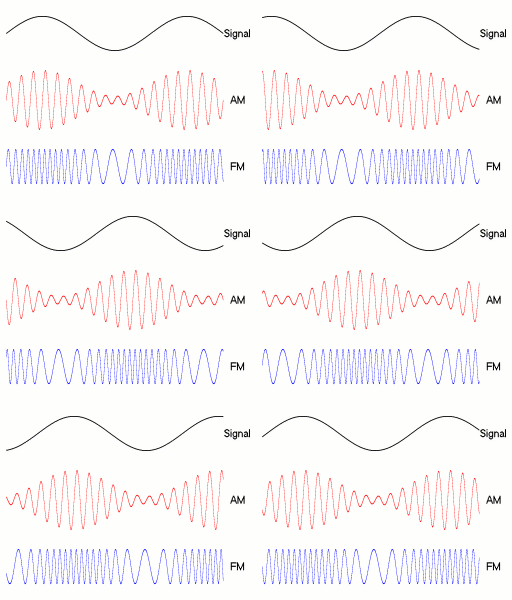
Everyone is familiar with FM from analogue VHF radio — there, a frequency deviation of 75 kHz and audio signals with a bandwidth of up to 15 kHz are used to deliver good audio quality. The modulation index is then five, and the bandwidth of a mono signal is around 180 kHz. With stereo and RDS data signals, the bandwidth of a typical VHF radio station expands to around 400 kHz.
That would be far too wide for amateur radio: the entire 2-metre band is only 2 MHz wide (144–146 MHz) — with a bandwidth of 400 kHz, there would only be room for five non-overlapping channels. Amateur radio therefore uses narrowband FM exclusively: for voice only, a mono signal with a maximum audio frequency of 3 kHz is sufficient; the typical deviation is 3–5 kHz, and the modulation index is approximately 1 to 1.7. This means that amateur FM signals have a bandwidth of 12–16 kHz, which allows for a channel spacing of 12.5 to 25 kHz.
Notes on operating procedures
When setting up the FM modulator, the maximum expected amplitude of the baseband signal is taken into account and the modulation depth adjusted accordingly. If a baseband signal that is too loud reaches the modulator, this inevitably results in a larger modulation depth than intended — the FM signal occupies more bandwidth and interferes with adjacent channels. This effect occurs even if someone speaks too loudly into the microphone or a new microphone produces a higher audio level than the old one.
For clean repeater operation, the following therefore applies: the radio transceiver and microphone should be matched to each other and to your own speaking volume. Otherwise, significant differences in modulation depth between different stations lead to fluctuating audio levels via the repeater — and as the modulation depth decreases, intelligibility declines. In short: please don’t shout too loudly — but there’s no need to whisper either.
Call tone and CTCSS
Many FM repeaters in Western and Central Europe are activated by a 1750 Hz call tone — a technique that has been standard for decades. All standard commercial radio transceivers for the European market have a 1750 Hz tone generator; in homemade radio transceivers, this can easily be retrofitted into the microphone lead.
Repeaters in other parts of the world — particularly North America — are, by contrast, activated using CTCSS sub-audio tones. In this case, the radio transceiver transmits a low-frequency tone that lies below the audible frequency range. There are 50 different frequencies between 67.0 and 254.1 Hz, 39 of which are standardised according to TIA/EIA-603-D. If the repeater detects a CTCSS tone at the correct frequency, it activates the transmitter. In Switzerland, too, CTCSS is active on many repeaters either in addition to or as an alternative to other modes — the exact settings can be found in the USKA repeater list.
Modern radio transceivers support sub-audio tones as standard. For older or homemade equipment, CTCSS can be retrofitted — somewhat more labour-intensive than a 1750 Hz tone generator, but feasible.
FM and emergency radio
Despite ongoing digitalisation, FM has been a firmly established transmission mode in the amateur radio service for decades. Almost every radio amateur has at least one FM transceiver for the 2 m and/or 70 cm bands. For local emergency radio communications, FM is therefore the transmission mode of choice: simple, robust, widely used and ready for immediate deployment. Many Swiss FM repeaters are equipped with an uninterruptible power supply, meaning they can remain operational for several hours even during power cuts — see also our page on EmComm (emergency radio).